Pages

Jumat, 14 Februari 2014

Introduction and Brief History of the Keris


Introduction and Brief History of the Keris
This small WEB is about keris. However, a discussion of the keris is a discussion of life in Javanese, Balinese, Madurenese, Sulawesi and other Indonesian Communities where the keris found and used. The keris occupies a special, important place in the community; it is not regarded merely as a weapon. In this part of the world, and particularly in Indonesia, there are many weapons which are considered to be sacred and endowed with supernatural powers, and therefore, must be respected; for examples, the Rencong of Aceh, Madau of Kalimantan, and Badik of South Sulawesi. A man feels safe when he has such weapons at his side.
These weapons were originally of the species referred to as stabbing weapons. Further development gave rise to variations in form and function, due to diverse factors such as geographical situation and environmental influences. The keris is one product of this evolution. It has achieved its present form and function after a sufficiently long era of development. This evolution has been in rhythm with the development of the culture as a whole, especially in Java.
To have a deeper understanding of the keris as it is regarded by the people, it is necessary, in this web, to describe briefly the parts briefly the parts of the keris it self, for it is a custom of the Indonesian and especially the Javanese communities to give a name to any and all products of handle work, however small the article maybe. Moreover, the keris in its use implicates a vast part of life. It seems to be a universal trait to link anything important closely with the way of life particularly the spiritual life: for example, as a conveyor of well-being, of happiness in life, and so forth.
In addition, the keris a result of the artistic expression of a community of the highest level, both as to shape or form as well as to components.
Therefore, there is a variety of kerises, in accordance with artistic development in each individual region. In this web the artistic elements of the keris will be enlarge upon separately.
Sincerely,

Introduction and Brief History of the Keris


Introduction and Brief History of the Keris
This small WEB is about keris. However, a discussion of the keris is a discussion of life in Javanese, Balinese, Madurenese, Sulawesi and other Indonesian Communities where the keris found and used. The keris occupies a special, important place in the community; it is not regarded merely as a weapon. In this part of the world, and particularly in Indonesia, there are many weapons which are considered to be sacred and endowed with supernatural powers, and therefore, must be respected; for examples, the Rencong of Aceh, Madau of Kalimantan, and Badik of South Sulawesi. A man feels safe when he has such weapons at his side.
These weapons were originally of the species referred to as stabbing weapons. Further development gave rise to variations in form and function, due to diverse factors such as geographical situation and environmental influences. The keris is one product of this evolution. It has achieved its present form and function after a sufficiently long era of development. This evolution has been in rhythm with the development of the culture as a whole, especially in Java.
To have a deeper understanding of the keris as it is regarded by the people, it is necessary, in this web, to describe briefly the parts briefly the parts of the keris it self, for it is a custom of the Indonesian and especially the Javanese communities to give a name to any and all products of handle work, however small the article maybe. Moreover, the keris in its use implicates a vast part of life. It seems to be a universal trait to link anything important closely with the way of life particularly the spiritual life: for example, as a conveyor of well-being, of happiness in life, and so forth.
In addition, the keris a result of the artistic expression of a community of the highest level, both as to shape or form as well as to components.
Therefore, there is a variety of kerises, in accordance with artistic development in each individual region. In this web the artistic elements of the keris will be enlarge upon separately.
Sincerely,

READ AREA : HISTORIES OF KRIS KRISSES KERIS SPIRITUAL FROM JAVANESE BE TRADITIONAL JAVA WEAPON BLADE


The kris or keris is a prized asymmetrical dagger most strongly associated with the culture of Indonesia, but also indigenous to Malaysia, Thailand, Brunei and Singapore. It is known as kalis in the southern Philippines. The kris is famous for its distinctive wavy blade, although many have straight blades as well.
A kris can be divided into three parts: bilah (blade), hulu (hilt), and warangka (sheath). These parts of the kris are objects of art, often carved in meticulous detail and made from various materials: metal, precious or rare types of wood, or gold or ivory. A kris's aesthetic value covers the dhapur (the form and design of the blade, with around 150 variants), the pamor (the pattern of metal alloy decoration on the blade, with around 60 variants), and tangguh referring to the age and origin of a kris.[1] Depending on the quality and historical value of the kris, it can fetch thousands of dollars or even more.
Both a weapon and spiritual object, kris are often considered to have an essence or presence, considered to possess magical powers, with some blades possessing good luck and others possessing bad.[1] Kris are used for display, as talismans with magical powers, weapons, a sanctified heirloom (pusaka), auxiliary equipment for court soldiers, an accessory for ceremonial dress, an indicator of social status, a symbol of heroism, etc.[1] Legendary kris that possess supernatural power and extraordinary ability were mentioned in traditional folktales, such as those of Mpu Gandring, Taming Sari, and Setan Kober.
In 2005, UNESCO gave the title Masterpiece of the Oral and Intangible Heritage of Humanity to the kris of Indonesia. In return, UNESCO urged Indonesia to preserve their heritage.[1]
Etymology[edit]
The origin of the word kris derives from the old Javanese term ngiris which means to slice, wedge or sliver. "Kris" is the more frequently used spelling in the West, but "keris" is more popular in the dagger's native lands,[2] as exemplified by the late Bambang Harsrinuksmo's popular book entitled Ensiklopedi Keris (Keris Encyclopedia). Two notable exceptions are the Philippines, where it is usually called kalis or kris, and Thailand where it is always spelled and pronounced as kris. Other spellings used by European colonists include "cryse", "crise", "criss", "kriss" and "creese".
History[edit]
Origins[edit]
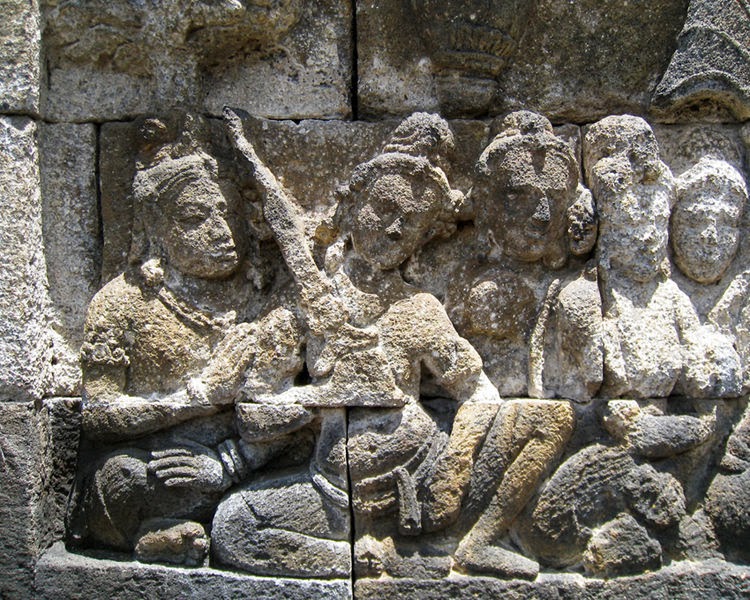
Kris depicted on Borobudur bas-relief.
Kris history is generally traced through the study of carvings and bas-relief panels found in Southeast Asia. It is believed that the earliest kris prototype can be traced to Dong Son bronze culture in Vietnam circa 300 BC that spread to other parts of Southeast Asia. Another theory is that the kris was based on daggers from India.[3] Some of the most famous renderings of a kris appear on the bas-reliefs of Borobudur (825) and Prambanan temple (850). However from Raffles' (1817) study of the Candi Sukuh that the kris recognized today came into existence around 1361 AD in the kingdom of Majapahit, East Java. The scene in bas relief of Sukuh Temple in Central Java dated from 15th century Majapahit era, shows the workshop of a Javanese keris blacksmith. The scene depicted Bhima as the blacksmith on the left forging the metal, Ganesha in the center, and Arjuna on the right operating the piston bellows to blow air into the furnace. The wall behind the blacksmith displays various items manufactured in the forge, including kris. These representations of the kris in Candi Sukuh established the fact that by the year 1437 the kris had already gained an important place within Javanese culture.
In Yingyai Shenglan — a record about Zheng He's expedition (1405-1433) — Ma Huan describes that all men in Majapahit, from the king to commoners, from a boy aged three to elders, slipped pu-la-t'ou (belati or more precisely kris dagger) in their belt. The dagger, made entirely of steel with intricate motifs smoothly drawn. The handles are made of gold, rhino’s horn or ivory carved with a depiction of human or demon, the carving works are exquisite and skillfully made.[4] This Chinese account also reported that public execution by stabbing using this type of dagger is common. Majapahit knows no caning for major or minor punishment. They tied the guilty men on his hands in the back with rattan rope and paraded them for a few paces, and then stabbed the offender one or two times in the back on the gap between floating rib, which resulted in severe bleeding and instant death.
The Sanghyang siksakanda ng karesian canto XVII, a Sundanese manuscript dated from Saka 1440 or 1518 AD, describes the kris as the weapon of kings, while the kujang is the weapon of farmers. There exist claims of earlier forms predating the Majapahit kris but none are verifiable. In the past, the majority of kris had straight blades but this became less frequent over time. Tomé Pires, in early 16th century, describes the importance of the kris to the Javanese: [5]
... every man in Java, whether he is rich or poor, must have a kris in his house .. and no man between the ages of 12 and 80 may go out of doors without a kris in his belt. They carry them at the back, as daggers used to be in Portugal...
— Tome Pires, Suma Oriental
While it is commonly believed that kris were the primary weapons wielded by fighters in the past, they were actually carried by warriors as a secondary armament if they lost their main weapon, which was usually a spear. For commoners however, kris were worn on a daily basis, especially when travelling because it might be needed for self-defense. During time of peace, people wore kris as part of ceremonial attire. Ceremonial kris were often meticulously decorated with intricate carving in gold and precious stones. Heirloom blades were handed down through successive generations and worn during special events such as weddings and other ceremonies. Men usually wore only one kris but the famous admiral Hang Tuah is said in the Hikayat Hang Tuah to have armed himself with one short and one long kris. Women also wore kris, though usually of a smaller size than a man's. In battle, a fighter might have carried more than one kris, some carried three kris: his own, one from his father-in-law, and one as a family heirloom. The extra two served as parrying daggers but if none were available, the sheath would serve the same purpose. Kris blacksmith's workshop depicted in 15th century Candi Sukuh.
Kris were often broken in battle and required repairs. Yearly cleanings, required as part of the spirituality and mythology surrounding the weapon, often left ancient blades worn and thin. The repair materials depended on location and it is quite usual to find a weapon with fittings from several areas. For example, a kris may have a blade from Java, a hilt from Bali and a sheath from Madura.
In many parts of Indonesia, the kris used to be the choice weapon for execution[citation needed]. The executioner's kris had a long, straight, slender blade. The condemned knelt before the executioner, who placed a wad of cotton or similar material on the subject's shoulder or clavicle area. The blade was thrust through the padding, piercing the subclavian artery and the heart. Upon withdrawal, the cotton wiped the blade clean. Death came within seconds.
In 16th century, European colonial power introduced firearms into the archipelago that contribute to the decline of kris' prominence as the weapon of choice in battle. However its spiritual and ceremonial function still continued and celebrated mainly in kraton and istana (courts) throughout Indonesia and Malaysia.
Kris today[edit]
Kris display
Until the 1990s, kris-making activities in Java had almost come to a standstill due to economic difficulties and changing socio-cultural values. However, thanks to several concerned kris experts, the tradition is being revived and kris craftsmanship has increased again.
Over the past three decades, kris have lost their prominent social and spiritual meaning in society. Although active and honoured empus (blademasters) who produce high quality kris in the traditional way can still be found on some places such Madura, Surakarta, Yogyakarta, Makassar and Palembang, their number is dramatically decreasing, and it is more difficult for them to find successors to whom they may transmit their skills.[1]
Description[edit]
A kris's aesthetic value covers the dhapur (the form and design of the blade, with around 150 variants), the pamor (the pattern of metal alloy decoration on the blade, with around 60 variants), and tangguh referring to the age and origin of a kris.[1] Blade[edit]
A decorative kris with a figure of Semar as the handle. The blade has thirteen luk.
The kris blade is called a wilah or bilah. Kris blades are usually narrow with a wide, asymmetrical base. The kris is famous for its wavy blade; however, the older types of kris dated from the Majapahit era have straight blades.[6] The number of luk or curves on the blade is always odd.[7] Common numbers of luk range from three to thirteen waves, but some blades have up to 29.[8] In contrast to the older straight type, most kris today have a wavy blade which is supposed to increase the severity of wounds inflicted upon a victim.[7] During kris stabbing, the wavy blade severs more blood vessels, creating a wider wound which causes the victim to easily bleed to death.[citation needed]
According to traditional Javanese kejawen, kris contain all the intrinsic elements of nature: tirta (water), bayu (wind), agni (fire), bantolo (earth, but also interpreted as metal or wood which both come from the earth), and aku (lit: "I" or "me", meaning that the kris has a spirit or soul). All these elements are present during the forging of kris. Earth is metal forged by fire being blown by pumped wind, and water to cool down the metal.[9] In Bali, the kris is associated with the nāga or dragon, which also symbolizes irrigation canals, rivers, springs, wells, spouts, waterfalls and rainbows; thus, the wavy blade symbolizes the movement of the serpent. Some kris have a naga or serpent head carved near the base with the body and tail following the curves of the blade to the tip. A wavy kris is thus a naga in motion, aggressive and alive; a straight blade is one at rest, its power dormant but ready to come into action.[10]
In former times, kris blades were said to be infused with poison during their forging, ensuring that any injury was fatal. The process of doing so was kept secret among smiths. Different types of whetstones, acidic juice of citrus fruits and poisonous arsenic bring out the contrast between the dark black iron and the light colored silvery nickel layers which together form pamor, damascene patterns on the blade. The distinctive pamor patterns have specific meanings and names which indicate the special magical properties they are believed to impart.
Hilt[edit]
Richly decorated Balinese kris hilt coated with gold, adorned with rubies
The handle or hilt (hulu) is the object of art, often carved in meticulous details and made from various materials; precious rare types of wood to gold or ivory. They were often carved to resemble various Hindu gods and deities, although this became less common with the introduction of Islam. In Bali, kris handles are made to resemble demons coated in gold and adorned with semi precious and precious stones, such as rubies. In Java, kris handles are made in various type, the most common design is the abstract stylized representation of the human form. Examples of hilt designs include Tunggak Semi Putri Kinurung hilt from Surakarta, Batara Guru and Pulasir hilt from Madura, Punukan hilt from Palembang, Ratmaja from Bali, Pulungan hilt from Cirebon, and a seabird-like hilt from Lampung and Sulawesi.[11] The kris usually has a curved pistol-grip hilt that aids in stabbing strikes. It allows the palm of the holding hand to add pressure to the blade while stabbing. A kris only offers minimal protection for the hand by the broad blade at the hilt. In rare cases, the blade may be forged so its axis lies at an angle to the hilt's axis. The intention is to get the blade automatically turning to slip past the ribs but this works poorly and makes the weapon less durable.[citation needed]
Sheath[edit]
As with the hilt, a kris's sheath (warangka) is also the object of art. It can be made from various materials, usually wooden frame to hold the blade which can be coated with metals; such as brass, iron, silver, or even gold, usually carved in sulur floral motifs. The upper part of sheath formed a broad curved handle made from wood or sometimes ivory. It could be adorned with precious or semi-precious stones.
Forging[edit]
The making of a kris was the specialised duty of metalworkers called empu or pandai besi (lit. "iron-skilled"). In Bali this occupation was preserved by the Pande clan to this day, members of whom also made jewellery. A bladesmith makes the blade in layers of different iron ores and meteorite nickel. Some blades can be made in a relatively short time, while more intricate weapons take years to complete. In high quality kris blades, the metal is folded dozens or hundreds of times and handled with the utmost precision. Empu are highly respected craftsmen with additional knowledge in literature, history, and the occult.[1] Cultural beliefs[edit]
Various ways of wearing kris in Javanese culture.
Kris were worn at special ceremonies, with heirloom blades being handed down through successive generations. Both men and women might wear them, though those for women are smaller. A rich spirituality and mythology developed around the weapon. Kris are used for display, as talismans with magical powers, weapons, sanctified heirloom, auxiliary equipment for court soldiers, as an accessory for ceremonial dress, an indicator of social status, a symbol of heroism, etc.[1]
In Javanese culture the kris is revered as tosan aji (Javanese for "sacred heirloom weapon") and considered a pusaka. The kris is believed to have the ability to infuse bravery upon its holder: this property is known as piyandel in Javanese which means "to add self-confidence". The pusaka kris or kris-tipped spear given by a Javanese king to nobles or his subjects, was meant to symbolize the king's confidence bestowed upon the receiver and is considered a great honor. During the Javanese wedding ceremony, a kris is required to be adorned with chains of jasmine flower arrangement as an important part of Javanese groom's wedding costume. The addition of jasmine arrangement around the kris was meant as a symbol that a man should not easily be angry, cruel, fierce, too aggressive, tyrannical and abusive.[8]
Kris-makers did more than forge the weapon, they carried out the old rituals which could infuse the blade with mystical powers. For this reason, kris are considered almost alive because they may be vessels of spirits, either good or evil. Legends tell of kris that could move of their own volition and killed individuals at will. Some kris are rumored to stand upright when their real names are called by their masters. It was said that some kris helped prevent fires, death, agricultural failure, and many other problems. Likewise, they could also bring fortune, such as bountiful harvests. Many of these beliefs, however, were erroneously derived from the possession of different kris by different people. For example, there is a type of kris in Java that was called Beras Wutah, which was believed to grant its possessor an easy life without famine. In reality, this kris was mainly assigned to government officers that were paid, in whole or in part with foodstuff such as rice.
There are several ways of testing whether a kris is lucky or not. A series of cuts on a leaf, based on blade width and other factors, could determine if a blade was good or bad. Also, if the owner slept with the blade under their pillow, the spirit of the kris would communicate with the owner via dream. If the owner had a bad dream, the blade was unlucky and had to be discarded, whereas if the owner had a good dream the dagger would bring good fortune. However, just because a blade was bad for one person didn't mean it would be bad for another. Harmony between the weapon and its owner was critical.
Because some kris are considered sacred and believed to possess magical powers, specific rites needed to be completed to avoid calling down evil fates which is the reason warriors often made offerings to their kris at a shrine. There is also the belief that pointing a kris at someone means they will die soon, so silat practitioners precede their demonstrations by touching the points of the blades to the ground so as to neutralise this effect.
Barong dance performance with kris-wielding dancers and Rangda in Bali
In the Barong dance of Bali there is a segment in which the villain Rangda magically enchants Airlangga's soldiers to commit suicide while another magician makes them invulnerable to sharp objects. In a trance state, the male dancers stab themselves in the chest with their own kris but remain unhurt.
Legends[edit]
Several folktales — linked to historical figures — mention legendary kris that possess supernatural power and extraordinary ability. Most of the magical kris are of Javanese origin, while the tales are derived from Javanese ancient manuscript, Babad (Javanese chronicle) and the Sejarah Melayu of Malaysia.
Kris Mpu Gandring[edit]
One of the most famous legends from Java comes from the Pararaton (Book of Kings). It describes a legendary bladesmith called Mpu Gandring or Empu Gandring and his impatient customer, Ken Arok, in the last days of the Kediri kingdom. The customer ordered a powerful kris to kill the mighty chieftain of Tumapel, Tunggul Ametung. Ken Arok eventually stabbed the old bladesmith to death because he kept delaying the scheduled completion of the kris. Dying, the bladesmith cursed the kris through prophesied that the unfinished or incomplete kris would kill seven men, including Ken Arok. Ken Arok used Mpu Gandring's cursed kris to assassinate Tunggul Ametung, cunningly put the blame to Kebo Ijo, and build a new kingdom of Singosari. The prophecy finally came true, with four men enlisted as the kris' first death roll, including Mpu Gandring himself, Tunggul Ametung, Kebo Ijo to whom Ken Arok lent the weapon, and finally Ken Arok himself. The unfinished kris then disappeared.[12][13]
Another version of the tale describes that the kris passed to Ken Arok's stepson Anusapati which in turn killed his stepfather after recognized that his genuine father was killed by Ken Arok with the same kris. The bloody feud continued on and on until the reign of Kertanegara, the last king of Singosari Empire
Kris Taming Sari[edit]
Taming Sari ("flower shield") is one of the most well-known kris in Malay literature, said to be so skilfully crafted that anyone wielding it was unbeatable. In some versions of the legend, the weapon would grant its user physical invulnerability. The legend took place sometime during the fall of Majapahit Empire and the rise of the Malacca Sultanate. Tun Sri Lanang's book, the Sejarah Melayu, tells that it was made by a Javanese empu and first used by the champion of Majapahit, a pendekar named Taming Sari. He was defeated in a duel to the death by the Melakan admiral Hang Tuah, after which the king of Majapahit presented the weapon to the victor.[7]
After being framed by a jealous official, Hang Tuah was ordered to be executed, but he managed to escape and go into hiding with the help of a minister who knew the truth. Hang Tuah's kris and title of Laksamana (admiral) were passed on to his comrade Hang Jebat. Furious that his best friend was unfairly put to death, Hang Jebat rebelled against the royalty and took over the palace. The desperate ruler of Melaka pardoned the minister so long as Hang Tuah could win him back the throne. Having trained under the same master since childhood the two friends were nearly equals but of the two, Tuah was the superior fighter. However, even after a long battle in the palace, neither could best the other because the Kris Taming Sari evened the odds. Only after taking his weapon back did Hang Tuah manage to stab Jebat, who died soon after.
Kris Setan Kober[edit]
Another Javanese folk story tells of Arya Penangsang, the mighty viceroy (adipati) of Jipang who was killed by his own kris called Setan Kober ("devil of the grave"). It was forged by Empu Bayu Aji in the kingdom of Pajajaran, and had 13 luk on its blade. Near its completion when the empu tried to infuse the weapon with spiritual power, he was disturbed by a crying demon (djinn) from the graveyard. As a result, although powerful, the kris had a temperamental evil nature that caused the wielder to be overly ambitious and impatient.
The story took place during the fall of Demak Sultanate that had replaced Majapahit as the ruler of Java. Setan Kober was safely kept by Sunan Kudus, one of the nine Islamic saints of Java. However Sunan Prawoto, son of Prince Trenggana and grandson of Raden Patah, stole it and used it to assassinate his uncle Raden Kikin by the river. Since then, Raden Kikin is also referred to as Sekar Seda Lepen (flower that fell by the river). Raden Trenggana rose as a sultan and later after his death, was replaced by Sunan Prawoto. Kikin's son, Arya Penangsang of Jipang with the help of his teacher, Sunan Kudus, took revenge by sending an assassin to kill Prawoto using the Setan Kober kris. Prawoto younger sister Ratu Kalinyamat seeks revenge on Penangsang, since Penangsang also murdered her husband. She urged her brother in-law, Hadiwijaya (Joko Tingkir) the ruler of Pajang, to kill Arya Penangsang. Hadiwijaya sent his adopted son and also his son in-law Sutawijaya, who would later become the first ruler of the Mataram dynasty.
During a battle, Sutawijaya stabbed Penangsang with Kyai Plered spear right in his gut. Arya Penangsang is bathing in his own blood, and his intestines were hanging from his open wounded stomach. However because Arya Penangsang is a mighty fighter that possess aji or kesaktian (spiritual power), he keep fighting with an open wounded stomach. He encircled his hanging intestines on his kris hilt, and continue to fight. When trying to attack his opponent, the reckless, fierce and impatience Panangsang pulled his Setan Kober off its sheath, foolishly cut his own intestines, and finally died.
The Javanese tradition of putting jasmine garlands around the kris hilt, especially on groom's kris during the wedding ceremony, is said to originate from this tale. It is to symbolyze that the groom should not be reckless, easily get angry, impatient and abusive like Arya Panangsang.[8] To replace the intestine, the kris is coiled with a floral garland of jasmine chain that resemble intestine. The jasmine is to symbolize sacredeness, patience, grace, humility, kindness and benevolence, the qualities lack in Panangsang. However another source mentioned that actually Sutawijaya admired Penangsang's fighting spirits, still fighting although his intestine encircled around his kris. Impressed by Penangsang's deed, later he command his male descendants to follow his step, adorned the kris with "intestine" made from the chain of jasmine, as a symbol of bravery. The story of Arya Penangsang has inspired and performed as Javanese ketoprak drama.[14]
Kris as a symbol[edit]
Hishammuddin Hussein's infamous waving of the kris as a symbol of Malay supremacy at the 2005 United Malays National Organisation Annual General Meeting
Throughout the archipelago, kris is a symbol of heroism,[1] martial prowess, power and authority. As a cultural symbol, the meticulously decorated keris represent refinement, art and beauty, as the pride and prized possession for its owner;[8] however, as a weapon it is associated with violence, death and bloodshed. Probably for this reason, although the kris is widespread in Javanese culture, it is not used to symbolise Javanese culture or royalty, as Javanese tradition promotes harmony and discourages direct confrontation (hence the absence of knives on Indonesian dinner tables). This is also why the Javanese traditionally wear the kris on their back, to symbolize violence as the last resort. However, in other parts of archipelago, from Sumatra to the Malay Peninsula and to Sulawesi, the kris is worn on the front or left side on the hip.
The kris is depicted on different emblems, coats and logos. For example, it can be seen in historical flag of Mataram Sultanate and former emblem of Siam to represent Malay minority in Southern Thailand. Kris is displayed in emblems of Riau, Riau Islands Province, Terengganu and Selangor. It also can be seen on an obverse copper-zinc-tin RM1 coin with a songket pattern in the background. The Malaya and British Borneo dollar 1 cent coin of 1962 also depicted a pair of crossed kris.
Since the independence of Malaysia, the kris has become something of a symbol of Malay nationalism. It is still regarded by some as a symbol of ketuanan Melayu, the doctrine of the Malay race as the dominant race at their homeland, and has been incorporated into the Sang Saka Bangsa, the official flag of the United Malays National Organisation.[15]
Kris depicted in several emblems as symbol:
[edit]
[edit]
------------------------------------------------------------------------------------
1. ^ Jump up to: a b c d e f g h i UNESCO Indonesian Kris
2. Jump up ^ Frey, Edward (2003). The Kris: Mystic Weapon of the Malay World. Selangor Darul Ehsan: Oxford University Press.
3. Jump up ^ Draeger & Smith (1969). Comprehensive Asian Fighting Arts. ISBN 978-0-87011-436-6.
4. Jump up ^ Ma Huan, translated by J. V. G. Mills (1970). "Ying Yai Shêng Lan Chiao Chu: The Overall Survey of the Ocean's
Shores' (1433)". books.google.co (Cambridge University Press for the Hakluyt Society). Retrieved November 14, 2013.
5. Jump up ^ Pires, Tomé (1990). The Suma oriental of Tome Pires: an account of the East. New Delhi: Asian Educational Services. p. 179. ISBN 81-206-0535-7.
6. Jump up ^ Museum Pusaka (Heirloom Museum) Taman Mini Indonesia Indah
7. ^ Jump up to: a b c An Introduction to Keris
8. ^ Jump up to: a b c d "Keris: Bawa Rasa Tosan Aji" (in Indonesian). Karaton Surakarta. Retrieved 2011-10-24.
9. Jump up ^ "Keris dan Budaya Spiritual Kejawen" (in Indonesian). Kalalima. 22 August 2011. Retrieved 2 July 2012.
10. Jump up ^ "Magic of Metal, Spiritual and Physical Powers of Keris". Neka Art Museum, Bali. Retrieved 2011-10-24.
11. Jump up ^ "Bentara Budaya Jakarta, Pameran Ragam Hulu Keris Nusantara". Java Keris. 9 July 2011. Retrieved 2011-10-24.
12. Jump up ^ eastjava.com, Majapahit Story.
13. Jump up ^ Indonesian Myth, Cursed Sword.
14. Jump up ^ Ketoprak Guyonan Campursari: Ariyo Penangsang Mbalelo
15. Jump up ^ Pogadaev, V. Magia Krisa (The Magic of Kris). Azia i Afrika Segodnya (Asia and Africa Today. Moscow, No. 4, 2010, 67–69
References[edit]
* Malay World Edged Weapons
Further reading[edit]
* David van Duuren, The Kris; An Earthly Approach to a Cosmic Symbol. Wijk en Aalburg (The Netherlands): Pictures Publishers, 1998.
* David van Duuren, Krisses; A Critical Bibliography. Wijk en Aalburg (The Netherlands): Pictures Publishers, 2002. * Gardner, Gerald B., Keris and Other Malay Weapons Orchid Press; Reprint Edition 2010 ISBN 978-974-8304-29-8 (Originally printed 1936 Singapore:Progressive Publishing Company)
* W.H. Rassers, 'On the Javanese kris', in: Bijdragen tot de Taal-, Land- en Volkenkunde 99, 1940, pp. 377–403. * Victor A. Pogadaev. "Ya Khochu Obruchit’sya s Krisom" (I Want to Be Engaged to a Keris). in: "Vostochnaya Kollektsia" (Oriental Collection). Moscow, Russian State Library. N 3 (30), 2007, 133–141. ISSN 1681-7559 External links[edit] * Keris Indonesia * Surprising find at Okinawa temple – The Star online. * The Kris in Java and Bali, Indonesia * A Kris home(start)page for collectors and enthusiasts, lots of info, links and photos can be found there. * v * t * e Knives and daggers * List of daggers * List of blade materials Types of knives * Aircrew Survival Egress Knife * Athame * Balisong/Butterfly * Ballistic * Ballpoint pen knife * Bayonet * Boline * Bolo * Boning * Boot knife * Bowie * Bread knife * Cane knife * Cheese knife * Chef's knife * Cleaver * Clip point * Combat knife * Commander * Corvo * CQC-6 * Dagger * Deba bōchō * Diving knife * Drop point * Electric knife * Fairbairn–Sykes fighting knife * Gerber Mark II * Ginsu * Grapefruit knife * Gravity knife * Gunong * Hunting dagger * Hunting knife * Jacob's ladder * Karambit * Kīla * Kirpan * Kitchen knife * Kukri * Laguiole knife * Machete * Mandau * Mezzaluna * Misericorde * Mora knife * Multi-tool * Nakiri bōchō * Navaja * Neck knife * Nontron knife * Opinel knife * Palette knife * Pantographic knife * Parang * Penknife * Penny knife * Pocket knife * Putty knife * Puukko * Rampuri * Rondel dagger * Sabatier * Sami knife * Santoku * SARK * Scalpel * Seax * Sgian dubh * Sharpfinger * Shiv * Sliding knife * Smatchet * SOG Knife * Straight razor * Strider SMF * Survival knife * Swiss Army knife * Switchblade * Taping knife * Throwing knife * Tomato knife * Trench knife * Tumi * Ulu * Utility knife * Warrior knife * X-Acto * Yanagi ba * Yatagan Types of daggers * Anelace * Applegate–Fairbairn fighting knife * Arkansas toothpick * BC-41 * Bagh nakh * Baselard * Bichawa * Bollock dagger * Cinquedea * Dirk * Ear dagger * Emeici * Facón * French Nail * Hachiwara * Hunting dagger * Janbiya * Kaiken * Kalis * Kard * Katar * Khanjar * Kris * Mark I trench knife * Ocean Edge Knife * Parrying dagger * Poignard * Push dagger * Seme * Shobo * Sica * Stiletto * Fairbairn-Sykes Fighting Knife * Tantō * Marine Raider stiletto * V-42 stiletto * Yarara Parachute Knife * Yoroidōshi Knife manufacturers * Aitor * Al Mar Knives * American Tomahawk Company * Bear MCG * Benchmade * Böker * Buck Knives * Caber * Camillus Cutlery Company * Cattaraugus Cutlery Company * Chris Reeve Knives * Cold Steel * Columbia River Knife & Tool * Cuisinart * Cutco Cutlery * DOVO Solingen * Dexter-Russell * Eikhorn * Ek Commando Knife Co. * Emerson Knives * Erizo * F. Dick * Fällkniven * FAMAE * Fiskars * Füritechnics * Gerber Legendary Blades * Global * Golok * Hanwei * Imperial Schrade * J. A. Henckels * KA-BAR * Kershaw Knives * KitchenAid * Korin Japanese Trading Company * Kyocera * Leatherman * Mad Dog Knives * MercWorx * Microtech Knives * Morseth * Murphy Knives * Ontario Knife Company * Opinel * Pro-Tech Knives * Randall Made Knives * Ranz * Rigid Knives * Rösle * SOG Specialty Knives * Sabatier Aîné & Perrier * Spyderco * Strider Knives * Survival Aids * TEKNA * Thiers Issard * Victorinox * W. R. Case & Sons Cutlery Co. * Walther arms * Wenger * Western Knife Company * Wilkinson Sword * Windlass Steelcrafts * Wüsthof * Yarara Ltd Knifemakers * A.G. Russell * American Bladesmith Society * Rex Applegate * James Black * Blackie Collins * John Nelson Cooper * Ernest Emerson * Jerry Fisk * Phill Hartsfield * Bill Harsey, Jr. * Gil Hibben * Knifemakers' Guild * Zanjan Knifemakers * Jimmy Lile * Bob Loveless * Bob Lum * William F. Moran * Ken Onion * Ralph Osterhout * Walter Doane "Bo" Randall, Jr. * Chris Reeve * Jody Samson * William Scagel * Robert Terzuola * Michael Walker * Buster Warenski * Daniel Winkler * Wikipedia book Book:Knives and daggers * Category Category:Knives / Daggers * v * t * e Notable swords Real Americas * Curved saber of San Martín Asia * Seven-Branched Sword * Sugari no Ontachi * Sword of Goujian Europe * Blessed sword and hat * Colada * Grunwald Swords * Joyeuse * Legbiter * Lobera * Seax of Beagnoth * Sword of Mercy * Sword of Saint Peter * Szczerbiec * Tizona * Wallace Sword Degen - Fig. 1,2,12. Neue preußische Degen. – 3 u. 4 Degen Philipps II. von Spanien. – 5. Degen ....jpg Mythical or legendary Asia * Asi * Cura Si Manjakini * Glory of Ten Powers * Kris Mpu Gandring * Kusanagi * Setan Kober * Shamshir-e Zomorrodnegar * Taming Sari * Thuận Thiên * Totsuka-no-Tsurugi * Zulfiqar Europe * Almace * Caladbolg * Carnwennan * Claíomh Solais * Clarent * Crocea Mors * Dáinsleif * Damocles * Durendal * Dyrnwyn * Excalibur (Caledfwlch) * Fragarach * Gram * Harpe * Hauteclere * Hǫfuð * Hrotti * Hrunting * Kladenets * Lævateinn * Mistilteinn * Murgleys * Nægling * Précieuse * Ridill * Skofnung * Sword of Attila * Tyrfing Some of the existing swords are named after earlier legendary ones. * v * t * e Sword types & classifications by region and era * Swordsmanship Europe Early history * Bronze Age sword Iron Age / Ancient Rome * Gladius * Xiphos * Kopis/Falcata * Makhaira * Spatha * Sica Middle Ages * Viking sword * Arming sword * Longsword * Claymore * Falchion * Shashka Renaissance * Zweihänder * Katzbalger * Cinquedea * Estoc * Side-sword * Espada ropera * Swiss degen Modern Era * Rapier * Sabre * Cutlass * Basket-hilted sword * Small sword * Dueling sword * Hunting sword * Pistol sword * Spadroon * Sword bayonet China Ancient * Jian * Dao Medieval * Dadao * Zhanmadao Ming – Qing * Liuyedao * Wodao * Changdao * Yanmaodao Modern * Miao dao Japan Yayoi – Nara periods * Chokutō Heian – Kamakura periods * Tachi * Ōdachi * Tantō Muromachi – Edo periods * Wakizashi * Uchigatana * Katana * Yoroidōshi Meiji period and beyond * Guntō India Ancient * Khanda * Firangi * Talwar * Kayamkulam vaal * Pata Indonesian Early period * Mandau * Parang * Klewang * Beladau * Surik * Badik Late period * Kris * Sundang * Rencong * Celurit * Cabang * Golok * Bendo * Arbir * Sikin Panjang Philippines Pre-Hispanic period * Kampilan * Kalis * Barong * Panabas Spanish colonization * Bolo * Balisword * Buntot Pagi * Espada y Daga * Dahong palay * Pinuti Middle East Scimitar type * Kilij * Shamshir * Saif * Kaskara * Flyssa * Takoba * Yatagan * Mameluke sword South and East Asia Formative stage * Hwandudaedo Classic stage * Khanda * Urumi * Hook sword * Dha * Seven-Branched Sword Post-Classic stage * Talwar * Kastane * Krabi Mesoamerica Pre-Columbian era * Macuahuitl * Macana Africa Ancient Egypt * Khopesh * Acinaces Mainland * Ida * Kaskara * Nimcha * Shotel * Billao Retrieved from "http://en.wikipedia.org/w/index.php?title=Kris&oldid=595262777" Categories: * Blade weapons * Daggers * Masterpieces of the Oral and Intangible Heritage of Humanity * Ritual weapons * Weapons of Java * Weapons of Indonesia
Quoted by : wikipedia.com

READ AREA : HISTORIES OF KRIS KRISSES KERIS SPIRITUAL FROM JAVANESE BE TRADITIONAL JAVA WEAPON BLADE


The kris or keris is a prized asymmetrical dagger most strongly associated with the culture of Indonesia, but also indigenous to Malaysia, Thailand, Brunei and Singapore. It is known as kalis in the southern Philippines. The kris is famous for its distinctive wavy blade, although many have straight blades as well.
A kris can be divided into three parts: bilah (blade), hulu (hilt), and warangka (sheath). These parts of the kris are objects of art, often carved in meticulous detail and made from various materials: metal, precious or rare types of wood, or gold or ivory. A kris's aesthetic value covers the dhapur (the form and design of the blade, with around 150 variants), the pamor (the pattern of metal alloy decoration on the blade, with around 60 variants), and tangguh referring to the age and origin of a kris.[1] Depending on the quality and historical value of the kris, it can fetch thousands of dollars or even more.
Both a weapon and spiritual object, kris are often considered to have an essence or presence, considered to possess magical powers, with some blades possessing good luck and others possessing bad.[1] Kris are used for display, as talismans with magical powers, weapons, a sanctified heirloom (pusaka), auxiliary equipment for court soldiers, an accessory for ceremonial dress, an indicator of social status, a symbol of heroism, etc.[1] Legendary kris that possess supernatural power and extraordinary ability were mentioned in traditional folktales, such as those of Mpu Gandring, Taming Sari, and Setan Kober.
In 2005, UNESCO gave the title Masterpiece of the Oral and Intangible Heritage of Humanity to the kris of Indonesia. In return, UNESCO urged Indonesia to preserve their heritage.[1]
Etymology[edit]
The origin of the word kris derives from the old Javanese term ngiris which means to slice, wedge or sliver. "Kris" is the more frequently used spelling in the West, but "keris" is more popular in the dagger's native lands,[2] as exemplified by the late Bambang Harsrinuksmo's popular book entitled Ensiklopedi Keris (Keris Encyclopedia). Two notable exceptions are the Philippines, where it is usually called kalis or kris, and Thailand where it is always spelled and pronounced as kris. Other spellings used by European colonists include "cryse", "crise", "criss", "kriss" and "creese".
History[edit]
Origins[edit]
Kris depicted on Borobudur bas-relief.
Kris history is generally traced through the study of carvings and bas-relief panels found in Southeast Asia. It is believed that the earliest kris prototype can be traced to Dong Son bronze culture in Vietnam circa 300 BC that spread to other parts of Southeast Asia. Another theory is that the kris was based on daggers from India.[3] Some of the most famous renderings of a kris appear on the bas-reliefs of Borobudur (825) and Prambanan temple (850). However from Raffles' (1817) study of the Candi Sukuh that the kris recognized today came into existence around 1361 AD in the kingdom of Majapahit, East Java. The scene in bas relief of Sukuh Temple in Central Java dated from 15th century Majapahit era, shows the workshop of a Javanese keris blacksmith. The scene depicted Bhima as the blacksmith on the left forging the metal, Ganesha in the center, and Arjuna on the right operating the piston bellows to blow air into the furnace. The wall behind the blacksmith displays various items manufactured in the forge, including kris. These representations of the kris in Candi Sukuh established the fact that by the year 1437 the kris had already gained an important place within Javanese culture.
In Yingyai Shenglan — a record about Zheng He's expedition (1405-1433) — Ma Huan describes that all men in Majapahit, from the king to commoners, from a boy aged three to elders, slipped pu-la-t'ou (belati or more precisely kris dagger) in their belt. The dagger, made entirely of steel with intricate motifs smoothly drawn. The handles are made of gold, rhino’s horn or ivory carved with a depiction of human or demon, the carving works are exquisite and skillfully made.[4] This Chinese account also reported that public execution by stabbing using this type of dagger is common. Majapahit knows no caning for major or minor punishment. They tied the guilty men on his hands in the back with rattan rope and paraded them for a few paces, and then stabbed the offender one or two times in the back on the gap between floating rib, which resulted in severe bleeding and instant death.
The Sanghyang siksakanda ng karesian canto XVII, a Sundanese manuscript dated from Saka 1440 or 1518 AD, describes the kris as the weapon of kings, while the kujang is the weapon of farmers. There exist claims of earlier forms predating the Majapahit kris but none are verifiable. In the past, the majority of kris had straight blades but this became less frequent over time. Tomé Pires, in early 16th century, describes the importance of the kris to the Javanese: [5]
... every man in Java, whether he is rich or poor, must have a kris in his house .. and no man between the ages of 12 and 80 may go out of doors without a kris in his belt. They carry them at the back, as daggers used to be in Portugal...
— Tome Pires, Suma Oriental
While it is commonly believed that kris were the primary weapons wielded by fighters in the past, they were actually carried by warriors as a secondary armament if they lost their main weapon, which was usually a spear. For commoners however, kris were worn on a daily basis, especially when travelling because it might be needed for self-defense. During time of peace, people wore kris as part of ceremonial attire. Ceremonial kris were often meticulously decorated with intricate carving in gold and precious stones. Heirloom blades were handed down through successive generations and worn during special events such as weddings and other ceremonies. Men usually wore only one kris but the famous admiral Hang Tuah is said in the Hikayat Hang Tuah to have armed himself with one short and one long kris. Women also wore kris, though usually of a smaller size than a man's. In battle, a fighter might have carried more than one kris, some carried three kris: his own, one from his father-in-law, and one as a family heirloom. The extra two served as parrying daggers but if none were available, the sheath would serve the same purpose. Kris blacksmith's workshop depicted in 15th century Candi Sukuh.
Kris were often broken in battle and required repairs. Yearly cleanings, required as part of the spirituality and mythology surrounding the weapon, often left ancient blades worn and thin. The repair materials depended on location and it is quite usual to find a weapon with fittings from several areas. For example, a kris may have a blade from Java, a hilt from Bali and a sheath from Madura.
In many parts of Indonesia, the kris used to be the choice weapon for execution[citation needed]. The executioner's kris had a long, straight, slender blade. The condemned knelt before the executioner, who placed a wad of cotton or similar material on the subject's shoulder or clavicle area. The blade was thrust through the padding, piercing the subclavian artery and the heart. Upon withdrawal, the cotton wiped the blade clean. Death came within seconds.
In 16th century, European colonial power introduced firearms into the archipelago that contribute to the decline of kris' prominence as the weapon of choice in battle. However its spiritual and ceremonial function still continued and celebrated mainly in kraton and istana (courts) throughout Indonesia and Malaysia.
Kris today[edit]
Kris display
Until the 1990s, kris-making activities in Java had almost come to a standstill due to economic difficulties and changing socio-cultural values. However, thanks to several concerned kris experts, the tradition is being revived and kris craftsmanship has increased again.
Over the past three decades, kris have lost their prominent social and spiritual meaning in society. Although active and honoured empus (blademasters) who produce high quality kris in the traditional way can still be found on some places such Madura, Surakarta, Yogyakarta, Makassar and Palembang, their number is dramatically decreasing, and it is more difficult for them to find successors to whom they may transmit their skills.[1]
Description[edit]
A kris's aesthetic value covers the dhapur (the form and design of the blade, with around 150 variants), the pamor (the pattern of metal alloy decoration on the blade, with around 60 variants), and tangguh referring to the age and origin of a kris.[1] Blade[edit]
A decorative kris with a figure of Semar as the handle. The blade has thirteen luk.
The kris blade is called a wilah or bilah. Kris blades are usually narrow with a wide, asymmetrical base. The kris is famous for its wavy blade; however, the older types of kris dated from the Majapahit era have straight blades.[6] The number of luk or curves on the blade is always odd.[7] Common numbers of luk range from three to thirteen waves, but some blades have up to 29.[8] In contrast to the older straight type, most kris today have a wavy blade which is supposed to increase the severity of wounds inflicted upon a victim.[7] During kris stabbing, the wavy blade severs more blood vessels, creating a wider wound which causes the victim to easily bleed to death.[citation needed]
According to traditional Javanese kejawen, kris contain all the intrinsic elements of nature: tirta (water), bayu (wind), agni (fire), bantolo (earth, but also interpreted as metal or wood which both come from the earth), and aku (lit: "I" or "me", meaning that the kris has a spirit or soul). All these elements are present during the forging of kris. Earth is metal forged by fire being blown by pumped wind, and water to cool down the metal.[9] In Bali, the kris is associated with the nāga or dragon, which also symbolizes irrigation canals, rivers, springs, wells, spouts, waterfalls and rainbows; thus, the wavy blade symbolizes the movement of the serpent. Some kris have a naga or serpent head carved near the base with the body and tail following the curves of the blade to the tip. A wavy kris is thus a naga in motion, aggressive and alive; a straight blade is one at rest, its power dormant but ready to come into action.[10]
In former times, kris blades were said to be infused with poison during their forging, ensuring that any injury was fatal. The process of doing so was kept secret among smiths. Different types of whetstones, acidic juice of citrus fruits and poisonous arsenic bring out the contrast between the dark black iron and the light colored silvery nickel layers which together form pamor, damascene patterns on the blade. The distinctive pamor patterns have specific meanings and names which indicate the special magical properties they are believed to impart.
Hilt[edit]
Richly decorated Balinese kris hilt coated with gold, adorned with rubies
The handle or hilt (hulu) is the object of art, often carved in meticulous details and made from various materials; precious rare types of wood to gold or ivory. They were often carved to resemble various Hindu gods and deities, although this became less common with the introduction of Islam. In Bali, kris handles are made to resemble demons coated in gold and adorned with semi precious and precious stones, such as rubies. In Java, kris handles are made in various type, the most common design is the abstract stylized representation of the human form. Examples of hilt designs include Tunggak Semi Putri Kinurung hilt from Surakarta, Batara Guru and Pulasir hilt from Madura, Punukan hilt from Palembang, Ratmaja from Bali, Pulungan hilt from Cirebon, and a seabird-like hilt from Lampung and Sulawesi.[11] The kris usually has a curved pistol-grip hilt that aids in stabbing strikes. It allows the palm of the holding hand to add pressure to the blade while stabbing. A kris only offers minimal protection for the hand by the broad blade at the hilt. In rare cases, the blade may be forged so its axis lies at an angle to the hilt's axis. The intention is to get the blade automatically turning to slip past the ribs but this works poorly and makes the weapon less durable.[citation needed]
Sheath[edit]
As with the hilt, a kris's sheath (warangka) is also the object of art. It can be made from various materials, usually wooden frame to hold the blade which can be coated with metals; such as brass, iron, silver, or even gold, usually carved in sulur floral motifs. The upper part of sheath formed a broad curved handle made from wood or sometimes ivory. It could be adorned with precious or semi-precious stones.
Forging[edit]
The making of a kris was the specialised duty of metalworkers called empu or pandai besi (lit. "iron-skilled"). In Bali this occupation was preserved by the Pande clan to this day, members of whom also made jewellery. A bladesmith makes the blade in layers of different iron ores and meteorite nickel. Some blades can be made in a relatively short time, while more intricate weapons take years to complete. In high quality kris blades, the metal is folded dozens or hundreds of times and handled with the utmost precision. Empu are highly respected craftsmen with additional knowledge in literature, history, and the occult.[1] Cultural beliefs[edit]
Various ways of wearing kris in Javanese culture.
Kris were worn at special ceremonies, with heirloom blades being handed down through successive generations. Both men and women might wear them, though those for women are smaller. A rich spirituality and mythology developed around the weapon. Kris are used for display, as talismans with magical powers, weapons, sanctified heirloom, auxiliary equipment for court soldiers, as an accessory for ceremonial dress, an indicator of social status, a symbol of heroism, etc.[1]
In Javanese culture the kris is revered as tosan aji (Javanese for "sacred heirloom weapon") and considered a pusaka. The kris is believed to have the ability to infuse bravery upon its holder: this property is known as piyandel in Javanese which means "to add self-confidence". The pusaka kris or kris-tipped spear given by a Javanese king to nobles or his subjects, was meant to symbolize the king's confidence bestowed upon the receiver and is considered a great honor. During the Javanese wedding ceremony, a kris is required to be adorned with chains of jasmine flower arrangement as an important part of Javanese groom's wedding costume. The addition of jasmine arrangement around the kris was meant as a symbol that a man should not easily be angry, cruel, fierce, too aggressive, tyrannical and abusive.[8]
Kris-makers did more than forge the weapon, they carried out the old rituals which could infuse the blade with mystical powers. For this reason, kris are considered almost alive because they may be vessels of spirits, either good or evil. Legends tell of kris that could move of their own volition and killed individuals at will. Some kris are rumored to stand upright when their real names are called by their masters. It was said that some kris helped prevent fires, death, agricultural failure, and many other problems. Likewise, they could also bring fortune, such as bountiful harvests. Many of these beliefs, however, were erroneously derived from the possession of different kris by different people. For example, there is a type of kris in Java that was called Beras Wutah, which was believed to grant its possessor an easy life without famine. In reality, this kris was mainly assigned to government officers that were paid, in whole or in part with foodstuff such as rice.
There are several ways of testing whether a kris is lucky or not. A series of cuts on a leaf, based on blade width and other factors, could determine if a blade was good or bad. Also, if the owner slept with the blade under their pillow, the spirit of the kris would communicate with the owner via dream. If the owner had a bad dream, the blade was unlucky and had to be discarded, whereas if the owner had a good dream the dagger would bring good fortune. However, just because a blade was bad for one person didn't mean it would be bad for another. Harmony between the weapon and its owner was critical.
Because some kris are considered sacred and believed to possess magical powers, specific rites needed to be completed to avoid calling down evil fates which is the reason warriors often made offerings to their kris at a shrine. There is also the belief that pointing a kris at someone means they will die soon, so silat practitioners precede their demonstrations by touching the points of the blades to the ground so as to neutralise this effect.
Barong dance performance with kris-wielding dancers and Rangda in Bali
In the Barong dance of Bali there is a segment in which the villain Rangda magically enchants Airlangga's soldiers to commit suicide while another magician makes them invulnerable to sharp objects. In a trance state, the male dancers stab themselves in the chest with their own kris but remain unhurt.
Legends[edit]
Several folktales — linked to historical figures — mention legendary kris that possess supernatural power and extraordinary ability. Most of the magical kris are of Javanese origin, while the tales are derived from Javanese ancient manuscript, Babad (Javanese chronicle) and the Sejarah Melayu of Malaysia.
Kris Mpu Gandring[edit]
One of the most famous legends from Java comes from the Pararaton (Book of Kings). It describes a legendary bladesmith called Mpu Gandring or Empu Gandring and his impatient customer, Ken Arok, in the last days of the Kediri kingdom. The customer ordered a powerful kris to kill the mighty chieftain of Tumapel, Tunggul Ametung. Ken Arok eventually stabbed the old bladesmith to death because he kept delaying the scheduled completion of the kris. Dying, the bladesmith cursed the kris through prophesied that the unfinished or incomplete kris would kill seven men, including Ken Arok. Ken Arok used Mpu Gandring's cursed kris to assassinate Tunggul Ametung, cunningly put the blame to Kebo Ijo, and build a new kingdom of Singosari. The prophecy finally came true, with four men enlisted as the kris' first death roll, including Mpu Gandring himself, Tunggul Ametung, Kebo Ijo to whom Ken Arok lent the weapon, and finally Ken Arok himself. The unfinished kris then disappeared.[12][13]
Another version of the tale describes that the kris passed to Ken Arok's stepson Anusapati which in turn killed his stepfather after recognized that his genuine father was killed by Ken Arok with the same kris. The bloody feud continued on and on until the reign of Kertanegara, the last king of Singosari Empire
Kris Taming Sari[edit]
Taming Sari ("flower shield") is one of the most well-known kris in Malay literature, said to be so skilfully crafted that anyone wielding it was unbeatable. In some versions of the legend, the weapon would grant its user physical invulnerability. The legend took place sometime during the fall of Majapahit Empire and the rise of the Malacca Sultanate. Tun Sri Lanang's book, the Sejarah Melayu, tells that it was made by a Javanese empu and first used by the champion of Majapahit, a pendekar named Taming Sari. He was defeated in a duel to the death by the Melakan admiral Hang Tuah, after which the king of Majapahit presented the weapon to the victor.[7]
After being framed by a jealous official, Hang Tuah was ordered to be executed, but he managed to escape and go into hiding with the help of a minister who knew the truth. Hang Tuah's kris and title of Laksamana (admiral) were passed on to his comrade Hang Jebat. Furious that his best friend was unfairly put to death, Hang Jebat rebelled against the royalty and took over the palace. The desperate ruler of Melaka pardoned the minister so long as Hang Tuah could win him back the throne. Having trained under the same master since childhood the two friends were nearly equals but of the two, Tuah was the superior fighter. However, even after a long battle in the palace, neither could best the other because the Kris Taming Sari evened the odds. Only after taking his weapon back did Hang Tuah manage to stab Jebat, who died soon after.
Kris Setan Kober[edit]
Another Javanese folk story tells of Arya Penangsang, the mighty viceroy (adipati) of Jipang who was killed by his own kris called Setan Kober ("devil of the grave"). It was forged by Empu Bayu Aji in the kingdom of Pajajaran, and had 13 luk on its blade. Near its completion when the empu tried to infuse the weapon with spiritual power, he was disturbed by a crying demon (djinn) from the graveyard. As a result, although powerful, the kris had a temperamental evil nature that caused the wielder to be overly ambitious and impatient.
The story took place during the fall of Demak Sultanate that had replaced Majapahit as the ruler of Java. Setan Kober was safely kept by Sunan Kudus, one of the nine Islamic saints of Java. However Sunan Prawoto, son of Prince Trenggana and grandson of Raden Patah, stole it and used it to assassinate his uncle Raden Kikin by the river. Since then, Raden Kikin is also referred to as Sekar Seda Lepen (flower that fell by the river). Raden Trenggana rose as a sultan and later after his death, was replaced by Sunan Prawoto. Kikin's son, Arya Penangsang of Jipang with the help of his teacher, Sunan Kudus, took revenge by sending an assassin to kill Prawoto using the Setan Kober kris. Prawoto younger sister Ratu Kalinyamat seeks revenge on Penangsang, since Penangsang also murdered her husband. She urged her brother in-law, Hadiwijaya (Joko Tingkir) the ruler of Pajang, to kill Arya Penangsang. Hadiwijaya sent his adopted son and also his son in-law Sutawijaya, who would later become the first ruler of the Mataram dynasty.
During a battle, Sutawijaya stabbed Penangsang with Kyai Plered spear right in his gut. Arya Penangsang is bathing in his own blood, and his intestines were hanging from his open wounded stomach. However because Arya Penangsang is a mighty fighter that possess aji or kesaktian (spiritual power), he keep fighting with an open wounded stomach. He encircled his hanging intestines on his kris hilt, and continue to fight. When trying to attack his opponent, the reckless, fierce and impatience Panangsang pulled his Setan Kober off its sheath, foolishly cut his own intestines, and finally died.
The Javanese tradition of putting jasmine garlands around the kris hilt, especially on groom's kris during the wedding ceremony, is said to originate from this tale. It is to symbolyze that the groom should not be reckless, easily get angry, impatient and abusive like Arya Panangsang.[8] To replace the intestine, the kris is coiled with a floral garland of jasmine chain that resemble intestine. The jasmine is to symbolize sacredeness, patience, grace, humility, kindness and benevolence, the qualities lack in Panangsang. However another source mentioned that actually Sutawijaya admired Penangsang's fighting spirits, still fighting although his intestine encircled around his kris. Impressed by Penangsang's deed, later he command his male descendants to follow his step, adorned the kris with "intestine" made from the chain of jasmine, as a symbol of bravery. The story of Arya Penangsang has inspired and performed as Javanese ketoprak drama.[14]
Kris as a symbol[edit]
Hishammuddin Hussein's infamous waving of the kris as a symbol of Malay supremacy at the 2005 United Malays National Organisation Annual General Meeting
Throughout the archipelago, kris is a symbol of heroism,[1] martial prowess, power and authority. As a cultural symbol, the meticulously decorated keris represent refinement, art and beauty, as the pride and prized possession for its owner;[8] however, as a weapon it is associated with violence, death and bloodshed. Probably for this reason, although the kris is widespread in Javanese culture, it is not used to symbolise Javanese culture or royalty, as Javanese tradition promotes harmony and discourages direct confrontation (hence the absence of knives on Indonesian dinner tables). This is also why the Javanese traditionally wear the kris on their back, to symbolize violence as the last resort. However, in other parts of archipelago, from Sumatra to the Malay Peninsula and to Sulawesi, the kris is worn on the front or left side on the hip.
The kris is depicted on different emblems, coats and logos. For example, it can be seen in historical flag of Mataram Sultanate and former emblem of Siam to represent Malay minority in Southern Thailand. Kris is displayed in emblems of Riau, Riau Islands Province, Terengganu and Selangor. It also can be seen on an obverse copper-zinc-tin RM1 coin with a songket pattern in the background. The Malaya and British Borneo dollar 1 cent coin of 1962 also depicted a pair of crossed kris.
Since the independence of Malaysia, the kris has become something of a symbol of Malay nationalism. It is still regarded by some as a symbol of ketuanan Melayu, the doctrine of the Malay race as the dominant race at their homeland, and has been incorporated into the Sang Saka Bangsa, the official flag of the United Malays National Organisation.[15]
Kris depicted in several emblems as symbol:
[edit]
[edit]
------------------------------------------------------------------------------------
1. ^ Jump up to: a b c d e f g h i UNESCO Indonesian Kris
2. Jump up ^ Frey, Edward (2003). The Kris: Mystic Weapon of the Malay World. Selangor Darul Ehsan: Oxford University Press.
3. Jump up ^ Draeger & Smith (1969). Comprehensive Asian Fighting Arts. ISBN 978-0-87011-436-6.
4. Jump up ^ Ma Huan, translated by J. V. G. Mills (1970). "Ying Yai Shêng Lan Chiao Chu: The Overall Survey of the Ocean's
Shores' (1433)". books.google.co (Cambridge University Press for the Hakluyt Society). Retrieved November 14, 2013.
5. Jump up ^ Pires, Tomé (1990). The Suma oriental of Tome Pires: an account of the East. New Delhi: Asian Educational Services. p. 179. ISBN 81-206-0535-7.
6. Jump up ^ Museum Pusaka (Heirloom Museum) Taman Mini Indonesia Indah
7. ^ Jump up to: a b c An Introduction to Keris
8. ^ Jump up to: a b c d "Keris: Bawa Rasa Tosan Aji" (in Indonesian). Karaton Surakarta. Retrieved 2011-10-24.
9. Jump up ^ "Keris dan Budaya Spiritual Kejawen" (in Indonesian). Kalalima. 22 August 2011. Retrieved 2 July 2012.
10. Jump up ^ "Magic of Metal, Spiritual and Physical Powers of Keris". Neka Art Museum, Bali. Retrieved 2011-10-24.
11. Jump up ^ "Bentara Budaya Jakarta, Pameran Ragam Hulu Keris Nusantara". Java Keris. 9 July 2011. Retrieved 2011-10-24.
12. Jump up ^ eastjava.com, Majapahit Story.
13. Jump up ^ Indonesian Myth, Cursed Sword.
14. Jump up ^ Ketoprak Guyonan Campursari: Ariyo Penangsang Mbalelo
15. Jump up ^ Pogadaev, V. Magia Krisa (The Magic of Kris). Azia i Afrika Segodnya (Asia and Africa Today. Moscow, No. 4, 2010, 67–69
References[edit]
* Malay World Edged Weapons
Further reading[edit]
* David van Duuren, The Kris; An Earthly Approach to a Cosmic Symbol. Wijk en Aalburg (The Netherlands): Pictures Publishers, 1998.
* David van Duuren, Krisses; A Critical Bibliography. Wijk en Aalburg (The Netherlands): Pictures Publishers, 2002. * Gardner, Gerald B., Keris and Other Malay Weapons Orchid Press; Reprint Edition 2010 ISBN 978-974-8304-29-8 (Originally printed 1936 Singapore:Progressive Publishing Company)
* W.H. Rassers, 'On the Javanese kris', in: Bijdragen tot de Taal-, Land- en Volkenkunde 99, 1940, pp. 377–403. * Victor A. Pogadaev. "Ya Khochu Obruchit’sya s Krisom" (I Want to Be Engaged to a Keris). in: "Vostochnaya Kollektsia" (Oriental Collection). Moscow, Russian State Library. N 3 (30), 2007, 133–141. ISSN 1681-7559 External links[edit] * Keris Indonesia * Surprising find at Okinawa temple – The Star online. * The Kris in Java and Bali, Indonesia * A Kris home(start)page for collectors and enthusiasts, lots of info, links and photos can be found there. * v * t * e Knives and daggers * List of daggers * List of blade materials Types of knives * Aircrew Survival Egress Knife * Athame * Balisong/Butterfly * Ballistic * Ballpoint pen knife * Bayonet * Boline * Bolo * Boning * Boot knife * Bowie * Bread knife * Cane knife * Cheese knife * Chef's knife * Cleaver * Clip point * Combat knife * Commander * Corvo * CQC-6 * Dagger * Deba bōchō * Diving knife * Drop point * Electric knife * Fairbairn–Sykes fighting knife * Gerber Mark II * Ginsu * Grapefruit knife * Gravity knife * Gunong * Hunting dagger * Hunting knife * Jacob's ladder * Karambit * Kīla * Kirpan * Kitchen knife * Kukri * Laguiole knife * Machete * Mandau * Mezzaluna * Misericorde * Mora knife * Multi-tool * Nakiri bōchō * Navaja * Neck knife * Nontron knife * Opinel knife * Palette knife * Pantographic knife * Parang * Penknife * Penny knife * Pocket knife * Putty knife * Puukko * Rampuri * Rondel dagger * Sabatier * Sami knife * Santoku * SARK * Scalpel * Seax * Sgian dubh * Sharpfinger * Shiv * Sliding knife * Smatchet * SOG Knife * Straight razor * Strider SMF * Survival knife * Swiss Army knife * Switchblade * Taping knife * Throwing knife * Tomato knife * Trench knife * Tumi * Ulu * Utility knife * Warrior knife * X-Acto * Yanagi ba * Yatagan Types of daggers * Anelace * Applegate–Fairbairn fighting knife * Arkansas toothpick * BC-41 * Bagh nakh * Baselard * Bichawa * Bollock dagger * Cinquedea * Dirk * Ear dagger * Emeici * Facón * French Nail * Hachiwara * Hunting dagger * Janbiya * Kaiken * Kalis * Kard * Katar * Khanjar * Kris * Mark I trench knife * Ocean Edge Knife * Parrying dagger * Poignard * Push dagger * Seme * Shobo * Sica * Stiletto * Fairbairn-Sykes Fighting Knife * Tantō * Marine Raider stiletto * V-42 stiletto * Yarara Parachute Knife * Yoroidōshi Knife manufacturers * Aitor * Al Mar Knives * American Tomahawk Company * Bear MCG * Benchmade * Böker * Buck Knives * Caber * Camillus Cutlery Company * Cattaraugus Cutlery Company * Chris Reeve Knives * Cold Steel * Columbia River Knife & Tool * Cuisinart * Cutco Cutlery * DOVO Solingen * Dexter-Russell * Eikhorn * Ek Commando Knife Co. * Emerson Knives * Erizo * F. Dick * Fällkniven * FAMAE * Fiskars * Füritechnics * Gerber Legendary Blades * Global * Golok * Hanwei * Imperial Schrade * J. A. Henckels * KA-BAR * Kershaw Knives * KitchenAid * Korin Japanese Trading Company * Kyocera * Leatherman * Mad Dog Knives * MercWorx * Microtech Knives * Morseth * Murphy Knives * Ontario Knife Company * Opinel * Pro-Tech Knives * Randall Made Knives * Ranz * Rigid Knives * Rösle * SOG Specialty Knives * Sabatier Aîné & Perrier * Spyderco * Strider Knives * Survival Aids * TEKNA * Thiers Issard * Victorinox * W. R. Case & Sons Cutlery Co. * Walther arms * Wenger * Western Knife Company * Wilkinson Sword * Windlass Steelcrafts * Wüsthof * Yarara Ltd Knifemakers * A.G. Russell * American Bladesmith Society * Rex Applegate * James Black * Blackie Collins * John Nelson Cooper * Ernest Emerson * Jerry Fisk * Phill Hartsfield * Bill Harsey, Jr. * Gil Hibben * Knifemakers' Guild * Zanjan Knifemakers * Jimmy Lile * Bob Loveless * Bob Lum * William F. Moran * Ken Onion * Ralph Osterhout * Walter Doane "Bo" Randall, Jr. * Chris Reeve * Jody Samson * William Scagel * Robert Terzuola * Michael Walker * Buster Warenski * Daniel Winkler * Wikipedia book Book:Knives and daggers * Category Category:Knives / Daggers * v * t * e Notable swords Real Americas * Curved saber of San Martín Asia * Seven-Branched Sword * Sugari no Ontachi * Sword of Goujian Europe * Blessed sword and hat * Colada * Grunwald Swords * Joyeuse * Legbiter * Lobera * Seax of Beagnoth * Sword of Mercy * Sword of Saint Peter * Szczerbiec * Tizona * Wallace Sword Degen - Fig. 1,2,12. Neue preußische Degen. – 3 u. 4 Degen Philipps II. von Spanien. – 5. Degen ....jpg Mythical or legendary Asia * Asi * Cura Si Manjakini * Glory of Ten Powers * Kris Mpu Gandring * Kusanagi * Setan Kober * Shamshir-e Zomorrodnegar * Taming Sari * Thuận Thiên * Totsuka-no-Tsurugi * Zulfiqar Europe * Almace * Caladbolg * Carnwennan * Claíomh Solais * Clarent * Crocea Mors * Dáinsleif * Damocles * Durendal * Dyrnwyn * Excalibur (Caledfwlch) * Fragarach * Gram * Harpe * Hauteclere * Hǫfuð * Hrotti * Hrunting * Kladenets * Lævateinn * Mistilteinn * Murgleys * Nægling * Précieuse * Ridill * Skofnung * Sword of Attila * Tyrfing Some of the existing swords are named after earlier legendary ones. * v * t * e Sword types & classifications by region and era * Swordsmanship Europe Early history * Bronze Age sword Iron Age / Ancient Rome * Gladius * Xiphos * Kopis/Falcata * Makhaira * Spatha * Sica Middle Ages * Viking sword * Arming sword * Longsword * Claymore * Falchion * Shashka Renaissance * Zweihänder * Katzbalger * Cinquedea * Estoc * Side-sword * Espada ropera * Swiss degen Modern Era * Rapier * Sabre * Cutlass * Basket-hilted sword * Small sword * Dueling sword * Hunting sword * Pistol sword * Spadroon * Sword bayonet China Ancient * Jian * Dao Medieval * Dadao * Zhanmadao Ming – Qing * Liuyedao * Wodao * Changdao * Yanmaodao Modern * Miao dao Japan Yayoi – Nara periods * Chokutō Heian – Kamakura periods * Tachi * Ōdachi * Tantō Muromachi – Edo periods * Wakizashi * Uchigatana * Katana * Yoroidōshi Meiji period and beyond * Guntō India Ancient * Khanda * Firangi * Talwar * Kayamkulam vaal * Pata Indonesian Early period * Mandau * Parang * Klewang * Beladau * Surik * Badik Late period * Kris * Sundang * Rencong * Celurit * Cabang * Golok * Bendo * Arbir * Sikin Panjang Philippines Pre-Hispanic period * Kampilan * Kalis * Barong * Panabas Spanish colonization * Bolo * Balisword * Buntot Pagi * Espada y Daga * Dahong palay * Pinuti Middle East Scimitar type * Kilij * Shamshir * Saif * Kaskara * Flyssa * Takoba * Yatagan * Mameluke sword South and East Asia Formative stage * Hwandudaedo Classic stage * Khanda * Urumi * Hook sword * Dha * Seven-Branched Sword Post-Classic stage * Talwar * Kastane * Krabi Mesoamerica Pre-Columbian era * Macuahuitl * Macana Africa Ancient Egypt * Khopesh * Acinaces Mainland * Ida * Kaskara * Nimcha * Shotel * Billao Retrieved from "http://en.wikipedia.org/w/index.php?title=Kris&oldid=595262777" Categories: * Blade weapons * Daggers * Masterpieces of the Oral and Intangible Heritage of Humanity * Ritual weapons * Weapons of Java * Weapons of Indonesia
Quoted by : wikipedia.com

BACAAN : SEJARAH SINGKAT PENGERTIAN DAN SEJARAH KERIS WIKIPEDIA SEBAGAI ADAT JAWA


Keris adalah senjata tikam golongan belati (berujung runcing dan tajam pada kedua sisinya) dengan banyak fungsi budaya yang dikenal di kawasan Nusantara bagian barat dan tengah. Bentuknya khas dan mudah dibedakan dari senjata tajam lainnya karena tidak simetris di bagian pangkal yang melebar, seringkali bilahnya berkelok-kelok, dan banyak di antaranya memiliki pamor (damascene), yaitu terlihat serat-serat lapisan logam cerah pada helai bilah. Jenis senjata tikam yang memiliki kemiripan dengan keris adalah badik. Senjata tikam lain asli Nusantara adalah kerambit.
Pada masa lalu keris berfungsi sebagai senjata dalam duel/peperangan,[1] sekaligus sebagai benda pelengkap sesajian. Pada penggunaan masa kini, keris lebih merupakan benda aksesori (ageman) dalam berbusana, memiliki sejumlah simbol budaya, atau menjadi benda koleksi yang dinilai dari segi estetikanya.
Penggunaan keris tersebar pada masyarakat penghuni wilayah yang pernah terpengaruh oleh Majapahit, seperti Jawa, Madura, Nusa Tenggara, Sumatera, pesisir Kalimantan, sebagian Sulawesi, Semenanjung Malaya, Thailand Selatan, dan Filipina Selatan (Mindanao). Keris Mindanao dikenal sebagai kalis. Keris di setiap daerah memiliki kekhasan sendiri-sendiri dalam penampilan, fungsi, teknik garapan, serta peristilahan.
Keris Indonesia telah terdaftar di UNESCO sebagai Warisan Budaya Dunia Non-Bendawi Manusia sejak 2005.[2]
Asal-usul dan fungsi[sunting | sunting sumber]
Asal-usul keris belum sepenuhnya terjelaskan karena tidak ada sumber tertulis yang deskriptif mengenainya dari masa sebelum abad ke-15, meskipun penyebutan istilah "keris" telah tercantum pada prasasti dari abad ke-9 Masehi. Kajian ilmiah perkembangan bentuk keris kebanyakan didasarkan pada analisis figur di relief candi atau patung. Sementara itu, pengetahuan mengenai fungsi keris dapat dilacak dari beberapa prasasti dan laporan-laporan penjelajah asing ke Nusantara.
Awal mula: Pengaruh India-Tiongkok[sunting | sunting sumber]Ge, belati-kapak dari Tiongkok Kuna (abad V SM sampai III SM), memperlihatkan pamor pada bilahnya.
Senjata tajam dengan bentuk yang diduga menjadi sumber inspirasi pembuatan keris dapat ditemukan pada peninggalan-peninggalan perundagian dari Kebudayaan Dongson dan Tiongkok selatan[3]. Dugaan pengaruh kebudayaan Tiongkok Kuna dalam penggunaan senjata tikam, sebagai cikal-bakal keris, dimungkinkan masuk melalui kebudayaan Dongson (Vietnam) yang merupakan "jembatan" masuknya pengaruh kebudayaan Tiongkok ke Nusantara. Sejumlah keris masa kini untuk keperluan sesajian memiliki gagang berbentuk manusia (tidak distilir seperti keris modern), sama dengan belati Dongson[3], dan menyatu dengan bilahnya.
Sikap menghormati berbagai benda-benda garapan logam dapat ditelusuri sebagai pengaruh India, khususnya Siwaisme[4]. Prasasti Dakuwu (abad ke-6) menunjukkan ikonografi India yang menampilkan "wesi aji" seperti trisula, kudhi, arit, dan keris sombro[5]. Para sejarawan umumnya bersepakat, keris dari periode pra-Singasari dikenal sebagai "keris Buda", yang berbentuk pendek dan tidak berluk (lurus), dan dianggap sebagai bentuk awal (prototipe) keris.[6] Beberapa belati temuan dari kebudayaan Dongson memiliki kemiripan dengan keris Buda dan keris sajen. Keris sajen memiliki bagian pegangan dari logam yang menyatu dengan bilah keris. Prototipe keris dari masa pra-Majapahit[sunting | sunting sumber]
Penggambaran benda mirip keris di relief Candi Borobudur.
Pahatan arca megalitik dan relief candi dari masa megalitikum sampai abad 10-11 penanggalan Masehi kebanyakan menampilkan bentuk-bentuk senjata tikam dan "wesi aji" lainnya yang mirip senjata dari Dongson maupun India. Bentuk senjata tikam yang diduga merupakan prototipe keris tersebut bilahnya belum memiliki kecondongan terhadap ganja sehingga bilah terkesan simetris, selain itu pada umumnya menunjukan hulu/deder/ukiran yang merupakan satu kesatuan dengan bilah (deder iras). Yang paling menyerupai keris adalah peninggalan megalitikum dari lembah Basemah Lahat Sumatera Selatan dari abad 10-5 SM yang menggambarkan kesatria sedang menunggang gajah dengan membawa senjata tikam (belati) sejenis dengan keris hanya saja kecondongan bilah bukan terhadap ganja tetapi terdapat kecondongan (derajat kemiringan) terhadap hulunya. Selain itu satu panel relief Candi Borobudur (abad ke-9) yang memperlihatkan seseorang memegang benda serupa keris tetapi belum memiliki derajat kecondongan dan hulu/deder nya masih menyatu dengan bilah.Dari abad yang sama, prasasti Karangtengah berangka tahun 824 Masehi menyebut istilah "keris" dalam suatu daftar peralatan[5]. Prasasti Poh (904 M) menyebut "keris" sebagai bagian dari sesaji yang perlu dipersembahkan[5]. Walaupun demikian, tidak diketahui apakah "keris" itu mengacu pada benda seperti yang dikenal sekarang.
Keris pusaka Knaud, salah satu contoh keris Buda.Relief rendah di Candi Penataran, Blitar. Perhatikan bagian hulu senjata yang tidak simetris dan bilah yang langsing menunjukkan ciri keris modern.
Dalam pengetahuan perkerisan Jawa (padhuwungan), keris dari masa pra-Kadiri-Singasari dikenal sebagai "keris Buda" atau "keris sombro". Keris-keris ini tidak berpamor dan sederhana[7]. Keris Buda dianggap sebagai bentuk pengawal keris modern. Contoh bentuk keris Buda yang kerap dikutip adalah keris keluarga Knaud dari Batavia yang didapat Charles Knaud, seorang Belanda peminat mistisisme Jawa, dari Sri Paku Alam V. Keris ini memiliki relief tokoh epik Ramayana pada permukaan bilahnya dan mencantumkan angka tahun Saka 1264 (1342 Masehi), sezaman dengan Candi Penataran, meskipun ada yang meragukan penanggalannya.
Keris Buda memiliki kemiripan bentuk dengan berbagai gambaran belati yang terlihat pada candi-candi di Jawa sebelum abad ke-11. Belati pada candi-candi ini masih memperlihatkan ciri-ciri senjata India, belum mengalami "pemribumian" (indigenisasi). Adanya berbagai penggambaran berbagai "wesi aji" sebagai komponen ikon-ikon dewa Hindu telah membawa sikap penghargaan terhadap berbagai senjata, termasuk keris kelak. Meskipun demikian, tidak ada bukti autentik mengenai evolusi perubahan dari belati gaya India menuju keris buda ini.
Kajian ikonografi bangunan dan gaya ukiran pada masa Kadiri-Singasari (abad ke-13 sampai ke-14) menunjukkan kecenderungan pemribumian dari murni India menuju gaya Jawa, tidak terkecuali dengan bentuk keris. Salah satu patung Siwa dari periode Singasari (abad ke-14 awal) memegang "wesi aji" yang mirip keris, berbeda dari penggambaran masa sebelumnya. Salah satu relief rendah (bas-relief) di dinding Candi Penataran juga menunjukkan penggunaan senjata tikam serupa keris. Candi Penataran (abad ke-11 sampai ke-13 M) dari masa akhir Kerajaan Kadiri di Blitar, Jawa Timur.
Keris modern[sunting | sunting sumber]
Sanggar Mpu pembuat keris ditampilkan dalam relief Candi Sukuh.
Belati tikam dan keris koleksi istana Pagarruyung. Belati tikam telah dikenal dari milenium pertama di Nusantara.
Keris modern yang dikenal saat ini diyakini para pemerhati keris memperoleh bentuknya pada masa Majapahit (abad ke-14) tetapi sesungguhnya relief di Candi Bahal peninggalan Kerajaan Panai/Pane (abad ke-11 M), sebagai bagian dari kerajaan Sriwijaya, di Portibi Sumatera Utara, menunjukan bahwa pada abad 10-11M keris modern sebagaimana yang dikenal sekarang sudah menemukan bentuknya, selain itu uji karbon pada keris temuan yang berasal dari Malang Jawa Timur yang ditemukan utuh beserta hulu/dedernya yang terbuat dari tulang sehingga terhadap dedernya dapat dilakukan analisis karbon, menunjukan hasil bahwa keris tersebut berasal dari abad 10M.
Berdasarkan relief keris modern paling awal pada candi Bahal Sumatera Utara dan penemuan keris budha dari Jawa Timur yang sama- sama menunjukan usia dari abad 10M dapatlah diperkirakan bahwa pada sekitar abad 10 masehi mulai tercipta keris dalam bentuk nya yang modern yang asimetris.
Dari abad ke-15, salah satu relief di Candi Sukuh, yang merupakan tempat pemujaan dari masa akhir Majapahit, dengan gamblang menunjukkan seorang empu tengah membuat keris. Relief ini pada sebelah kiri menggambarkan Bhima sebagai personifikasi empu tengah menempa besi, Ganesha di tengah, dan Arjuna tengah memompa tabung peniup udara untuk tungku pembakaran. Dinding di belakang empu menampilkan berbagai benda logam hasil tempaan, termasuk keris.
... . Orang-orang ini [Majapahit] selalu mengenakan pu-la-t'ou (belati? atau beladau?)yang diselipkan pada ikat pinggang. [...], yang terbuat dari baja, dengan pola yang rumit dan bergaris-garis halus pada daunnya; hulunya terbuat dari emas, cula, atau gading yang diukir berbentuk manusia atau wajah raksasa dengan garapan yang sangat halus dan rajin.
— Ma Huan, "Ying-yai Sheng-lan Fai"Catatan Ma Huan dari tahun 1416, anggota ekspedisi Cheng Ho, dalam "Ying-yai Sheng-lan" menyebutkan bahwa orang-orang Majapahit selalu mengenakan (pu-la-t'ou)yang diselipkan pada ikat pinggang. Mengenai kata Pu-la-t'ou ini, meskipun hanya berdasarkan kemiripan bunyi, banyak yang berpendapat bahwa yang dimaksud adalah "belati", dan karena keris adalah senjata tikam sebagaimana belati maka dianggap pu-la-t'ou menggambarkan keris. Tampaknya masih harus dilakukan penelitian apakah betul pada masa majapahit keris disebut "belati" tetapi terdapat deskripsi yang menggambarkann bahwa "belati" ini adalah keris dan teknik pembuatan pamor telah berkembang baik.[8].
Bisa jadi yang dimaksud oleh Ma Huan dengan Pulat'ou adalah "Beladau". Kata "beladau" lebih menyerupai "Pu- La-T'ou" daripada "belati". Kalau benar yang dimaksud Ma Huan adalah beladau pada maka gambaran Ma Huan tentang senjata yang banyak digunakan di Majapahit ini bukan keris tetapi senjata tradisional sejenis Badik yang sekarang banyak digunakan di Sumatera yang bentuknya melengkung mirip Jambiya, meskipun senjata ini memiliki kecondongan tetapi tidak memiliki ganja dan gandik sehingga tidak dapat digolongkan sebgai keris. Anggapan bahwa yang dimaksud dengan Pu-La-T'ou adalah Beladau pun masih memerlukan penelitian apakah memang pada masa majapahit masyarakat banyak memakai beladau/sejenis badik sebagai senjata.
...Senjata sang prabu ialah: pedang, abet (pecut), pamuk, golok, peso teundeut, keris. Raksasa yang dijadikan dewanya, karena digunakan untuk membunuh...
— Sanghyang siksakanda ng karesian, Pupuh XVII
Keris disebutkan dalam naskah Sunda dari tahun 1440 Saka (1518 M), Sanghyang siksakanda ng karesian pupuh XVII, yang menyebutkan bahwa keris adalah senjata Prabu, (raja, golongan ksatriya).[9] Naskah ini membagi senjata dalam masyarakat Kerajaan Sunda ke dalam tiga golongan; senjata untuk prabu (raja, menak, atau golongan ksatriya) adalah pedang, pecut, pamuk, golok, peso teundeut, dan keris; senjata untuk kaum petani adalah kujang, baliung, patik, kored, dan pisau sadap; sementara senjata kaum pendeta adalah kala katri, peso raut, peso dongdang, pangot, dan pakisi.
... setiap laki-laki di Jawa, tidak peduli kaya atau miskin, harus memiliki sebilah keris di rumahnya ... dan tidak ada satu pun laki-laki berusia antara 12 dan 80 tahun bepergian tanpa sebilah keris di sabuknya. Keris diletakkan di punggung, seperti belati di Portugal...
— Tome Pires, "Suma Oriental"Tome Pires, penjelajah Portugis dari abad ke-16, menyinggung tentang kebiasaan penggunaan keris oleh laki-laki Jawa[10]. Deskripsinya tidak jauh berbeda dari yang disebutkan Ma Huan seabad sebelumnya.
Berita-berita Portugis dan Perancis dari abad ke-17 telah menunjukkan penggunaan meluas pamor dan pemakaian pegangan keris dari kayu, tanduk, atau gading di berbagai tempat di Nusantara[11].
Perkembangan fungsi keris[sunting | sunting sumber]
Pada masa kini, keris memiliki fungsi yang beragam dan hal ini ditunjukkan oleh beragamnya bentuk keris yang ada.Keris sebagai elemen persembahan sebagaimana dinyatakan oleh prasasti-prasasti dari milenium pertama menunjukkan keris sebagai bagian dari persembahan. Pada masa kini, keris juga masih menjadi bagian dari sesajian. Lebih jauh, keris juga digunakan dalam ritual/upacara mistik atau paranormal. Keris untuk penggunaan semacam ini memiliki bentuk berbeda, dengan pesi menjadi hulu keris, sehingga hulu menyatu dengan bilah keris. Keris semacam ini dikenal sebagai keris sesajian atau "keris majapahit" (tidak sama dengan keris tangguh Majapahit)!.
Pemaparan-pemaparan asing menunjukkan fungsi keris sebagai senjata di kalangan awam Majapahit. Keris sebagai senjata memiliki bilah yang kokoh, keras, tetapi ringan. Berbagai legenda dari periode Demak–Mataram mengenal beberapa keris senjata yang terkenal, misalnya keris Nagasasra Sabukinten.
Laporan Perancis dari abad ke-16 telah menceritakan peran keris sebagai simbol kebesaran para pemimpin Sumatera (khususnya Kesultanan Aceh)[12]. Godinho de Heredia dari Portugal menuliskan dalam jurnalnya dari tahun 1613 bahwa orang-orang Melayu penghuni Semenanjung ("Hujung Tanah") telah memberikan racun pada bilah keris dan menghiasi sarung dan hulu keris dengan batu permata[13].
"Penghalusan" fungsi keris tampaknya semakin menguat sejak abad ke-19 dan seterusnya, sejalan dengan meredanya gejolak politik di Nusantara dan menguatnya penggunaan senjata api. Dalam perkembangan ini, peran keris sebagai senjata berangsur-angsur berkurang. Sebagai contoh, dalam idealisme Jawa mengenai seorang laki-laki "yang sempurna", sering dikemukakan bahwa keris atau curiga menjadi simbol pegangan ilmu/keterampilan sebagai bekal hidup[14][15]. Berkembangnya tata krama penggunaan keris maupun variasi bentuk sarung keris (warangka) yang dikenal sekarang dapat dikatakan juga merupakan wujud penghalusan fungsi keris. Berbagai cara mengenakan keris berdasarkan Kebudayaan Jawa.
Pada masa kini, kalangan perkerisan Jawa selalu melihat keris sebagai tosan aji atau "benda keras (logam) yang luhur", bukan sebagai senjata. Keris adalah dhuwung, bersama-sama dengan tombak; keduanya dianggap sebagai benda "pegangan" (ageman) yang diambil daya keutamaannya dengan mengambil bentuk senjata tikam pada masa lalu. Di Malaysia, dalam kultur monarki yang kuat, keris menjadi identitas kemelayuan.
Tata cara penggunaan keris berbeda-beda di masing-masing daerah. Di daerah Jawa dan Sunda misalnya, keris ditempatkan di pinggang bagian belakang pada masa damai tetapi ditempatkan di depan pada masa perang. Penempatan keris di depan dapat diartikan sebagai kesediaan untuk bertarung. Selain itu, terkait dengan fungsi, sarung keris Jawa juga memiliki variasi utama: gayaman dan ladrang. Sementara itu, di Sumatra, Kalimantan, Malaysia, Brunei dan Filipina, keris ditempatkan di depan dalam upacara-upacara kebesaran.
Senjata tajam dengan bentuk yang diduga menjadi sumber inspirasi pembuatan keris dapat ditemukan pada peninggalan-peninggalan perundagian dari Kebudayaan Dongson dan Tiongkok selatan[3]. Dugaan pengaruh kebudayaan Tiongkok Kuna dalam penggunaan senjata tikam, sebagai cikal-bakal keris, dimungkinkan masuk melalui kebudayaan Dongson (Vietnam) yang merupakan "jembatan" masuknya pengaruh kebudayaan Tiongkok ke Nusantara. Sejumlah keris masa kini untuk keperluan sesajian memiliki gagang berbentuk manusia (tidak distilir seperti keris modern), sama dengan belati Dongson[3], dan menyatu dengan bilahnya.
Sikap menghormati berbagai benda-benda garapan logam dapat ditelusuri sebagai pengaruh India, khususnya Siwaisme[16]. Prasasti Dakuwu (abad ke-6) menunjukkan ikonografi India yang menampilkan "wesi aji" seperti trisula, kudhi, arit, dan keris sombro[5]. Para sejarawan umumnya bersepakat, keris dari periode pra-Singasari dikenal sebagai "keris Buda", yang berbentuk pendek dan tidak berluk (lurus), dan dianggap sebagai bentuk awal (prototipe) keris.[17] Beberapa belati temuan dari kebudayaan Dongson memiliki kemiripan dengan keris Buda dan keris sajen. Keris sajen memiliki bagian pegangan dari logam yang menyatu dengan bilah keris. Bahan, pembuatan, dan perawatan[sunting | sunting sumber]
Logam dasar yang digunakan dalam pembuatan keris ada dua macam logam adalah logam besi dan logam pamor, sedangkan pesi keris terbuat dari baja. Untuk membuatnya ringan para Empu selalu memadukan bahan dasar ini dengan logam lain. Keris masa kini (nèm-nèman, dibuat sejak abad ke-20) biasanya memakai logam pamor nikel. Keris masa lalu (keris kuna) yang baik memiliki logam pamor dari batu meteorit yang diketahui memiliki kandungan titanium yang tinggi, di samping nikel, kobal, perak, timah putih, kromium, antimonium, dan tembaga. Batu meteorit yang terkenal adalah meteorit Prambanan, yang pernah jatuh pada abad ke-19 di kompleks percandian Prambanan.
Pembuatan keris bervariasi dari satu empu ke empu lainnya, tetapi terdapat prosedur yang biasanya bermiripan. Berikut adalah proses secara ringkas menurut salah satu pustaka[18]. Bilah besi sebagai bahan dasar diwasuh atau dipanaskan hingga berpijar lalu ditempa berulang-ulang untuk membuang pengotor (misalnya karbon serta berbagai oksida). Setelah bersih, bilah dilipat seperti huruf U untuk disisipkan lempengan bahan pamor di dalamnya. Selanjutnya lipatan ini kembali dipanaskan dan ditempa. Setelah menempel dan memanjang, campuran ini dilipat dan ditempa kembali berulang-ulang. Cara, kekuatan, dan posisi menempa, serta banyaknya lipatan akan memengaruhi pamor yang muncul nantinya. Proses ini disebut saton. Bentuk akhirnya adalah lempengan memanjang. Lempengan ini lalu dipotong menjadi dua bagian, disebut kodhokan. Satu lempengan baja lalu ditempatkan di antara kedua kodhokan seperti roti sandwich, diikat lalu dipijarkan dan ditempa untuk menyatukan. Ujung kodhokan lalu dibuat agak memanjang untuk dipotong dan dijadikan ganja. Tahap berikutnya adalah membentuk pesi, bengkek (calon gandhik), dan terakhir membentuk bilah apakah berluk atau lurus. Pembuatan luk dilakukan dengan pemanasan.
Tahap selanjutnya adalah pembuatan ornamen-ornamen (ricikan) dengan menggarap bagian-bagian tertentu menggunakan kikir, gerinda, serta bor, sesuai dengan dhapur keris yang akan dibuat. Silak waja dilakukan dengan mengikir bilah untuk melihat pamor yang terbentuk. Ganja dibuat mengikuti bagian dasar bilah. Ukuran lubang disesuaikan dengan diameter pesi.
Tahap terakhir, yaitu penyepuhan, dilakukan agar logam keris menjadi logam besi baja. Pada keris Filipina tidak dilakukan proses ini. Penyepuhan ("menuakan logam") dilakukan dengan memasukkan bilah ke dalam campuran belerang, garam, dan perasan jeruk nipis (disebut kamalan). Penyepuhan juga dapat dilakukan dengan memijarkan keris lalu dicelupkan ke dalam cairan (air, air garam, atau minyak kelapa, tergantung pengalaman Empu yang membuat). Tindakan penyepuhan harus dilakukan dengan hati-hati karena bila salah dapat membuat bilah keris retak.
Selain cara Penyepuhan yang lazim seperti diatas dalam penyepuhan Keris dikenal pula Sepuh jilat yaitu pada saat logam Keris membara diambil dan dijilati dengan lidah, Sepuh Akep yaitu pada saat logam Keris membara diambil dan dikulum dengan bibir beberapa kali dan Sepuh Saru yaitu pada saat logam Keris membara diambil dan dijepit dengan alat kelamin wanita (Vagina) Sepuh Saru ini yang terkenal adalah Nyi Sombro, bentuk kerisnya tidak besar tapi disesuaikan.[rujukan?]
Pemberian warangan dan minyak pewangi dilakukan sebagaimana perawatan keris pada umumnya. Perawatan keris dalam tradisi Jawa dilakukan setiap tahun, biasanya pada bulan Muharram/Sura, meskipun hal ini bukan keharusan. Istilah perawatan keris adalah "memandikan" keris, meskipun yang dilakukan sebenarnya adalah membuang minyak pewangi lama dan karat pada bilah keris, biasanya dengan cairan asam (secara tradisional menggunakan air buah kelapa, hancuran buah mengkudu, atau perasan jeruk nipis). Bilah yang telah dibersihkan kemudian diberi warangan bila perlu untuk mempertegas pamor, dibersihkan kembali, dan kemudian diberi minyak pewangi untuk melindungi bilah keris dari karat baru. Minyak pewangi ini secara tradisional menggunakan minyak melati atau minyak cendana yang diencerkan pada minyak kelapa.
Morfologi[sunting | sunting sumber]
Bagian ini tidak memiliki referensi sumber tepercaya sehingga isinya tidak bisa diverifikasi.
Bantulah memperbaiki artikel ini dengan menambahkan referensi yang layak.
Materi yang tidak dapat diverifikasikan dapat dihapus sewaktu-waktu oleh Pengurus.
Beberapa istilah di bagian ini diambil dari tradisi Jawa, semata karena rujukan yang tersedia.
Keris atau dhuwung terdiri dari tiga bagian utama, yaitu bilah (wilah atau daun keris), ganja ("penopang"), dan hulu keris (ukiran, pegangan keris). Bagian yang harus ada adalah bilah. Hulu keris dapat terpisah maupun menyatu dengan bilah. Ganja tidak selalu ada, tapi keris-keris yang baik selalu memilikinya. Keris sebagai senjata dan alat upacara dilindungi oleh sarung keris atau warangka.
Bilah keris merupakan bagian utama yang menjadi identifikasi suatu keris. Pengetahuan mengenai bentuk (dhapur) atau morfologi keris menjadi hal yang penting untuk keperluan identifikasi. Bentuk keris memiliki banyak simbol spiritual selain nilai estetika. Hal-hal umum yang perlu diperhatikan dalam morfologi keris adalah kelokan (luk), ornamen (ricikan), warna atau pancaran bilah, serta pola pamor. Kombinasi berbagai komponen ini menghasilkan sejumlah bentuk standar (dhapur) keris yang banyak dipaparkan dalam pustaka-pustaka mengenai keris.
Pengaruh waktu memengaruhi gaya pembuatan. Gaya pembuatan keris tercermin dari konsep tangguh, yang biasanya dikaitkan dengan periodisasi sejarah maupun geografis, serta empu yang membuatnya.
Hulu atau pegangan keris[sunting | sunting sumber]
Sebuah keris dengan pegangan berbentuk Semar
Pegangan keris (bahasa Jawa: gaman, atau hulu keris) ini bermacam-macam motifnya, untuk keris Bali ada yang bentuknya menyerupai dewa, pedande (pendeta), raksasa, penari, pertapa hutan dan ada yang diukir dengan kinatah emas dan batu mulia dan biasanya bertatahkan batu mirah delima.
Pegangan keris Sulawesi menggambarkan burung laut. Hal itu sebagai perlambang terhadap sebagian profesi masyarakat Sulawesi yang merupakan pelaut, sedangkan burung adalah lambang dunia atas keselamatan. Seperti juga motif kepala burung yang digunakan pada keris Riau Lingga, dan untuk daerah-daerah lainnya sebagai pusat pengembangan tosan aji seperti Aceh, Bangkinang (Riau) , Palembang, Sambas, Kutai, Bugis, Luwu, Jawa, Madura dan Sulu, keris mempunyai ukiran dan perlambang yang berbeda. Selain itu, materi yang dipergunakan pun berasal dari aneka bahan seperti gading, tulang, logam, dan yang paling banyak yaitu kayu.
Untuk pegangan keris Jawa, secara garis besar terdiri dari sirah wingking ( kepala bagian belakang ) , jiling, cigir, cetek, bathuk (kepala bagian depan) ,weteng dan bungkul.
Warangka atau sarung keris[sunting | sunting sumber]Warangka, atau sarung keris (bahasa Banjar : kumpang), adalah komponen keris yang mempunyai fungsi tertentu, khususnya dalam kehidupan sosial masyarakat Jawa, paling tidak karena bagian inilah yang terlihat secara langsung. Warangka yang mula-mula dibuat dari kayu (yang umum adalah jati, cendana, timoho, dan kemuning). Sejalan dengan perkembangan zaman terjadi penambahan fungsi wrangka sebagai pencerminan status sosial bagi penggunanya. Bagian atasnya atau ladrang-gayaman sering diganti dengan gading.
Secara garis besar terdapat dua bentuk warangka, yaitu jenis warangka ladrang yang terdiri dari bagian-bagian : angkup, lata, janggut, gandek, godong (berbentuk seperti daun), gandar, ri serta cangkring. Dan jenis lainnya adalah jenis wrangka gayaman (gandon) yang bagian-bagiannya hampir sama dengan wrangka ladrang tetapi tidak terdapat angkup, godong, dan gandek.
Aturan pemakaian bentuk wrangka ini sudah ditentukan, walaupun tidak mutlak. Wrangka ladrang dipakai untuk upacara resmi , misalkan menghadap raja, acara resmi keraton lainnya (penobatan, pengangkatan pejabat kerajaan, perkawinan, dll) dengan maksud penghormatan. Tata cara penggunaannya adalah dengan menyelipkan gandar keris di lipatan sabuk (stagen) pada pinggang bagian belakang (termasuk sebagai pertimbangan untuk keselamatan raja ). Sedangkan wrangka gayaman dipakai untuk keperluan harian, dan keris ditempatkan pada bagian depan (dekat pinggang) ataupun di belakang (pinggang belakang).
Dalam perang, yang digunakan adalah keris wrangka gayaman , pertimbangannya adalah dari sisi praktis dan ringkas, karena wrangka gayaman lebih memungkinkan cepat dan mudah bergerak, karena bentuknya lebih sederhana.
Ladrang dan gayaman merupakan pola-bentuk wrangka, dan bagian utama menurut fungsi wrangka adalah bagian bawah yang berbentuk panjang ( sepanjang wilah keris ) yang disebut gandar atau antupan ,maka fungsi gandar adalah untuk membungkus wilah (bilah) dan biasanya terbuat dari kayu ( dipertimbangkan untuk tidak merusak wilah yang berbahan logam campuran ) .
Karena fungsi gandar untuk membungkus , sehingga fungsi keindahannya tidak diutamakan, maka untuk memperindahnya akan dilapisi seperti selongsong-silinder yang disebut pendok . Bagian pendok ( lapisan selongsong ) inilah yang biasanya diukir sangat indah , dibuat dari logam kuningan, suasa ( campuran tembaga emas ) , perak, emas . Untuk daerah diluar Jawa ( kalangan raja-raja Bugis , Goa, Palembang, Riau, Bali ) pendoknya terbuat dari emas , disertai dengan tambahan hiasan seperti sulaman tali dari emas dan bunga yang bertaburkan intan berlian.
Untuk keris Jawa , menurut bentuknya pendok ada tiga macam, yaitu (1) pendok bunton berbentuk selongsong pipih tanpa belahan pada sisinya , (2) pendok blewah (blengah) terbelah memanjang sampai pada salah satu ujungnya sehingga bagian gandar akan terlihat , serta (3) pendok topengan yang belahannya hanya terletak di tengah . Apabila dilihat dari hiasannya, pendok ada dua macam yaitu pendok berukir dan pendok polos (tanpa ukiran).
Wilah atau bilah keris[sunting | sunting sumber]Keris Moro (kalis) dari Sulu, bilah tidak dituakan dan tidak berpamor.Wilah, wilahan, atau bilah adalah bagian utama dari sebuah keris. Wilah keris adalah logam yang ditempa sedemikian rupa sehingga menjadi senjata tajam. Wilah terdiri dari bagian-bagian tertentu yang tidak sama untuk setiap wilahan, yang biasanya disebut dapur, atau penamaan ragam bentuk pada wilah-bilah (ada puluhan bentuk dapur). Sebagai contoh, bisa disebutkan dapur jangkung mayang, jaka lola , pinarak, jamang murub, bungkul , kebo tedan, pudak sitegal, dll.
Pada pangkal wilahan terdapat pesi , yang merupakan ujung bawah sebilah keris atau tangkai keris. Bagian inilah yang masuk ke pegangan keris ( ukiran) . Pesi ini panjangnya antara 5 cm sampai 7 cm, dengan penampang sekitar 5 mm sampai 10 mm, bentuknya bulat panjang seperti pensil. Di daerah Jawa Timur disebut paksi, di Riau disebut puting, sedangkan untuk daerah Serawak, Brunei dan Malaysia disebut punting.
Pada pangkal (dasar keris) atau bagian bawah dari sebilah keris disebut ganja (untuk daerah semenanjung Melayu menyebutnya aring). Di tengahnya terdapat lubang pesi (bulat) persis untuk memasukkan pesi, sehingga bagian wilah dan ganja tidak terpisahkan. Pengamat budaya tosan aji mengatakan bahwa kesatuan itu melambangkan kesatuan lingga dan yoni, dimana ganja mewakili lambang yoni sedangkan pesi melambangkan lingganya. Ganja ini sepintas berbentuk cecak, bagian depannya disebut sirah cecak, bagian lehernya disebut gulu meled , bagian perut disebut wetengan dan ekornya disebut sebit ron. Ragam bentuk ganja ada bermacam-macam, wilut , dungkul , kelap lintah dan sebit rontal.
Luk, adalah bagian yang berkelok dari wilah-bilah keris, dan dilihat dari bentuknya keris dapat dibagi dua golongan besar, yaitu keris yang lurus dan keris yang bilahnya berkelok-kelok atau luk. Salah satu cara sederhana menghitung luk pada bilah , dimulai dari pangkal keris ke arah ujung keris, dihitung dari sisi cembung dan dilakukan pada kedua sisi seberang-menyeberang (kanan-kiri), maka bilangan terakhir adalah banyaknya luk pada wilah-bilah dan jumlahnya selalu gasal ( ganjil) dan tidak pernah genap, dan yang terkecil adalah luk tiga (3) dan terbanyak adalah luk tiga belas (13). Jika ada keris yang jumlah luk nya lebih dari tiga belas, biasanya disebut keris kalawija, atau keris tidak lazim.
Pasikutan, tangguh keris, dan perkembangan pada masa kini[sunting | sunting sumber] Lihat pula artikel Tangguh keris.Yang dimaksud dengan pasikutan adalah "roman" atau kesan emosi yang dibangkitkan oleh wujud suatu keris. Biasanya, personifikasi disematkan pada suatu keris, misalnya suatu keris tampak seperti "bungkuk", "tidak bersemangat", "riang", "tidak seimbang", dan sebagainya[19]. Kemampuan menengarai pasikutan merupakan tahap lanjut dalam mendalami ilmu perkerisan dan membawa seseorang pada panangguhan keris.
Langgam/gaya pembuatan suatu keris dipengaruhi oleh zaman, tempat tinggal dan selera empu yang membuatnya. Dalam istilah perkerisan Jawa, langgam keris menurut waktu dan tempat ini diistilahkan sebagai tangguh. Tangguh dapat juga diartikan sebagai "perkiraan", maksudnya adalah perkiraan suatu keris mengikuti gaya suatu zaman atau tempat tertentu. "Penangguhan" keris pada umumnya dilakukan terhadap keris-keris pusaka, meskipun keris-keris baru dapat juga dibuat mengikuti tangguh tertentu, tergantung keinginan pemilik keris atau empunya.
Tangguh keris tidak bersifat mutlak karena deskripsi setiap tangguh pun dapat bersifat tumpang tindih. Selain itu, pustaka-pustaka lama tidak memiliki kesepakatan mengenai empu-empu yang dimasukkan ke dalam suatu tangguh. Hal ini disebabkan tradisi lisan yang sebelum abad ke-20 dipakai dalam ilmu padhuwungan.
Meskipun tangguh tidak identik dengan umur, tangguh keris (Jawa) yang tertua yang dapat dijumpai saat ini adalah tangguh Buda (atau keris Buda). Keris modern pusaka tertua dianggap berasal dari tangguh Pajajaran, yaitu dari periode ketika sebagian Jawa Tengah masih di bawah pengaruh Kerajaan Galuh. Keris pusaka termuda adalah dari masa pemerintahan Pakubuwana X (berakhir 1939). Selanjutnya, kualitas pembuatan keris terus merosot, bahkan di Surakarta pada dekade 1940-an tidak ada satu pun pandai keris yang bertahan [20].
Kebangkitan seni kriya keris di Surakarta dimulai pada tahun 1970, dibidani oleh K.R.T. Hardjonagoro (Go Tik Swan) dan didukung oleh Sudiono Humardani[20], melalui perkumpulan Bawa Rasa Tosan Aji. Perlahan-lahan kegiatan pandai keris bangkit kembali dan akhirnya ilmu perkerisan juga menjadi satu program studi pada Sekolah Tinggi Seni Indonesia Surakarta (sekarang ISI Surakarta).
Keris-keris yang dibuat oleh para pandai keris sekarang dikenal sebagai keris kamardikan ("keris kemerdekaan"). Periode ini melahirkan beberapa pandai keris kenamaan dari Solo[20] seperti KRT. Supawijaya (Solo), Pauzan Pusposukadgo (Solo), tim pandai keris STSI Surakarta, Harjosuwarno (bekerja pada studio milik KRT Hardjonagoro di Solo), Suparman Wignyosukadgo (Solo)[21].
SUMBER : http://id.wikipedia.org/wiki/Keris

_____

Popular Posts

 
Blogger Templates